


This week I went to the cinema to watch The Devil Wears Prada 2.
I was 14 when the first one came out, and it was one of those movies that sparked my obsession with this industry. The outfits, the offices, the impossible pace, the feeling of being part of not just any industry, but fashion.
I remember thinking: this is it, this is what I want to do every day.
Yesterday I sat in the theater with a completely different perspective.
First of all, because of the job I do, watching it was technically work. The teenager in me who loved the first movie was a little nervous — hoping not to be disappointed, because we all know how much buzz this sequel has generated.
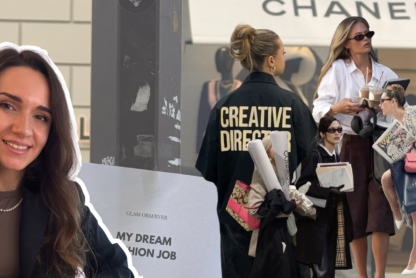
If you’d like, you can watch and listen to my latest YouTube video, where I talk not only about the film, but also about whether the world of fashion is really portrayed as it appears in the movie, and the difference between perception and reality in today’s fashion industry.
The press tour was huge. I live in Milan, and even my neighbor sent me the link to apply as a comparsa in the movie: “you’d be perfect for this.” (The shy person in me — and the busy one — couldn’t bear standing in line for hours, so I said no.)
Then the filming days came and Anne Hathaway and Meryl Streep were here, in Milan. Then the premiere, the Rinascente pop-up, the personalized Starbucks coffees, the Runway Magazine activations everywhere. You know I felt this movie.
I went to the theater alone. 6:30pm. Like I was actually working. I sat down and just hoped it would be as good as the first one — because the first one is iconic, and the expectations were sky-high. But I knew it had to be different. Because well… now I’m in. And fashion is different.
Lights down, 20th Century Studios logo, goosebumps. Already.
But I didn’t leave the theater with the same emotion as the first movie. Let me explain — because it’s not what you think.
As soon as I got home I had this strange feeling that I just wanted to rewatch the first movie. Even though I know it by heart. Maybe I wanted something lighter, funnier. Maybe I wanted the dream version again.
Watching the sequel, more than 10 years into my own career in fashion, hit completely differently.
Was the first movie too fictional? Or was the industry actually like that back then?
I was too young to be inside, so I genuinely don’t know — some people who lived it say it was exactly like that, others say it was exaggerated. But now I am inside, and I have my own perspective on what’s real and what’s not. So I watched this new movie with very different eyes.
(And I’m honestly curious — if you’re a student who is not yet in the industry, what was your perspective? Tell me in the comments.)
Honestly? This new movie represents the fashion industry much more realistically.
Does that mean it’s less fun than the first one?
Probably yes — if you’re watching it as a comedy, and less as a documentary.
But if you’re reading this article, you want to work in fashion. Which means you’re watching with both eyes: one as entertainment, one as someone spying inside what this industry actually looks like today.
If what made you laugh in the first movie was Miranda throwing her coats on her assistant’s desk — well, spoiler: in the sequel, Miranda has to hang her coat herself because HR said she’s not allowed to do that anymore. If you were expecting that same sarcasm, it’s gone. But from a work perspective, you might actually be happier that the job is no longer about catching coats or finding the impossible Harry Potter manuscript for your boss’s daughters.
The movie shows the changes happening in fashion. And if you want to work in this industry, you cannot ignore how the industry is positioned today.
Years ago, Miranda had all the power. In this new movie, Irv calls and hires Andy without Miranda’s approval. And that detail — small as it seems — represents reality. Miranda in 2006 could move oceans. Now she has to act within constraints. The empire she rules is half the size it used to be. The print issue is gone. The shoots are compressed. The billionaires are circling. HR is writing rules. And her new assistant is setting boundaries that would have been unthinkable in 2006, when no one could tell Miranda what she could or couldn’t say.
Here’s what I want you to understand: fashion companies are organizations.
Realistically, there isn’t one single person who decides everything — especially in the big ones. There’s structure. There are systems. There are rules. This new movie represents what the reality of a big-structure company actually looks like — and if you want to be in fashion, that structure and that hierarchy are things you need to understand before you walk in.
I once believed Miranda really did have all that power. That an editor-in-chief at the time really could decide everything. But once you actually work in fashion, you understand something the first movie never showed you: magazines are not just pages of pretty photos and shopping suggestions. They are businesses. And like any business, they depend on funding, investors, and revenue streams.
Editorial power today is deeply connected to financial power.
And that changes everything — from creative direction to hiring decisions to the future of the publication itself.
This is exactly what the second movie shows.
It shows how the industry has evolved: magazines going digital and struggling to find new revenue streams, an icon like Miranda who can no longer fly first class because of budget cuts, the Vogue World–style live events becoming the new way magazines stay relevant, and the new job title everyone aspires to — no longer editor-in-chief, but global head of content.
(Which, by the way, is a real, existing title — and the most important shift in fashion media you should know about.)
It shows how the entire journalism field is being rewritten by the digital transition. Slower budgets, faster turnarounds, new metrics for what “success” even means.
The sequel also makes very clear something the first movie never bothered to: most big fashion magazines don’t operate alone. They are part of bigger publishing groups. Vogue, GQ, Vanity Fair, Architectural Digest, Glamour, Allure, Wired, Bon Appétit — all part of Condé Nast. Harper’s Bazaar, Elle, Cosmopolitan, Town & Country, Esquire — all part of Hearst. And the group level has enormous power over what happens at any individual magazine.
In the first movie, it was all about Runway. In the sequel, we see there’s something bigger behind it. We see Irv’s son — clearly representing the publishing-group level — wanting to sell the company, and how risky that is for a single magazine. We see how a rich man could buy the publication and decide what gets published.
It immediately reminded me of the rumors about Jeff Bezos and Condé Nast.
Whether those rumors are true or not, the fact that these conversations exist at all tells you everything about where the power has moved.
We also see how important advertisers still are. A poorly handled article ruins the magazine’s reputation. A major brand like Dior asks for things in return for their ad spend. Cover stories and editorials are dictated by forces that go far beyond the creativity of any one editor or photographer.
This is the industry. And if you’re trying to break in, you need to know it.
Beyond the obvious — print decline, billionaire owners, advertiser power — there are three more things this movie quietly shows that I think matter even more for anyone trying to enter the industry right now.
You don’t need to be “creative” to have a career in fashion.
Andy comes back to Runway as features editor. Not as a stylist. Not as a fashion editor. Not as someone with an “eye.” She comes back because she’s a journalist — someone who can write, investigate, structure a story, and hold a publication’s editorial integrity.
Her path back into fashion has nothing to do with having a sense of style.
This is the part nobody says out loud: You do not need to be a creative person to build a career in fashion.
The industry needs writers, editors, project managers, marketers, data analysts, e-commerce specialists, supply chain experts, finance people, lawyers, HR leaders, sustainability strategists, retail operations, CRM managers, performance marketing specialists, content producers, community managers. None of these roles require you to be the next Phoebe Philo. None of them require an “eye.” Many of them don’t even require a fashion degree.
And if you’re reading this article, it means that you truly love fashion and want to be part of it. You just don’t know how yet — and that’s where I come in. I created my Fashion Academy to help fellow fashion enthusiasts start their careers in the industry. Here’s the link to my course, Break Into Fashion Industry.
If you love this industry but you’ve spent years thinking I’m not creative enough to belong here — please stop telling yourself that story. Fashion companies are companies. They need every kind of professional that any other industry needs. The difference is just that they happen to sell beautiful things.
The first movie sold us the idea that to belong in fashion you had to be a Miranda or a Nigel — visionary, taste-driven, born with style. The sequel quietly corrects that: Andy is back, and she is not creative in the fashion sense. She’s competent in the editorial sense. And that’s enough.
If you’re analytical, structured, strategic, organizational, numerical, operational — there is absolutely a place for you in fashion. In fact, there’s a bigger place for you than there’s ever been, because as the industry becomes more corporate and more complex, it needs more of these profiles, not fewer.
Fashion is finally open to people without the “right” qualifications
This is the part I want you to really hold onto, because it’s the most optimistic message in the entire movie, and the one most directly relevant to anyone who has ever felt like an outsider looking in.
The first movie made it very clear what it took to belong in fashion. Miranda told Andy to her face: you have no style or sense of fashion. The implication was brutal — there was a right kind of person to be in this industry, and Andy was not it. The unspoken qualifications were taste, a particular aesthetic, the right schools, the right city, the right last name, the right look.
The sequel doesn’t say any of that anymore.
Look at the world the sequel paints. Andy comes back not because she fits a mold, but because she has a skill. The new assistant has boundaries and isn’t there to be molded into a Miranda clone. The power is more distributed, the rules are being rewritten, and the gatekeepers no longer have the same grip on who is “allowed” to be in fashion.
This is the most important thing the movie shows for those who want to enter the fashion industry, and it’s also exactly what’s happening in real life:
You no longer need the standard qualifications to make it in fashion.
You don’t need to come from Milan, Paris, or New York. You don’t need a famous last name. You don’t need to have grown up surrounded by Vogue archives. You don’t need a Central Saint Martins degree. You don’t need the “look.” You don’t need to have known you wanted this since you were 5.
Ten years ago, those things were obstacles. Today, they barely matter.
What matters is that you can execute, that you understand the industry well enough to add value, and that you stop waiting for permission. The doors that used to be guarded by a small group of people who decided who belonged are now opening from a hundred different directions — through brand-side roles, through digital, through content, through independent platforms, through skills that didn’t even have job titles five years ago.
If you’ve ever held back from pursuing fashion because you thought you weren’t the “type” — this is your sign. The industry the first movie sold us, the one where Miranda decided who deserved to be there, is gone. The industry that exists today is more open to outsiders than it has ever been.
And honestly? That’s the best news this movie gives us.
So… Should You Still Want to Work in Fashion?
Yes. More than ever.
The dream available today is, I think, better. More realistic. More accessible. More open to people like me — and like you — who didn’t grow up in the right city, with the right last name, with the “right” sense of style.
Does it mean is easier? Unfortunately, no, it’s still very competitive, but with the right strategies you can make it!
If reading this is making you realize that the career strategies you are using to apply for fashion jobs and internships need a serious update, that’s exactly why I created my free webinar. I walk you through what works to stand out in fashion nowadays.