
If you’ve ever stared at a blank Word document, wondering what on earth to put in a fashion CV, you are not alone.
I remember that exact feeling. I was about to graduate in management engineering, not fashion, with no connections, no industry experience, and no idea how to present myself to the brands I dreamed of working for. I had never worked in fashion. And yet I landed internships at the same time at Fendi, Santoni, and then Alexander McQueen (I then chose Alexander McQueen).
My CV wasn’t impressive by conventional standards. But it was built strategically.
After ten years working in the fashion industry and mentoring thousands of students through Glam Observer, I’ve reviewed hundreds of fashion CVs. I know exactly what makes recruiters stop — and what makes them move on in three seconds.
This guide will show you how to write a fashion CV that works in 2026, whether you’re starting from scratch or updating what you already have.
How To Build A Fashion CV
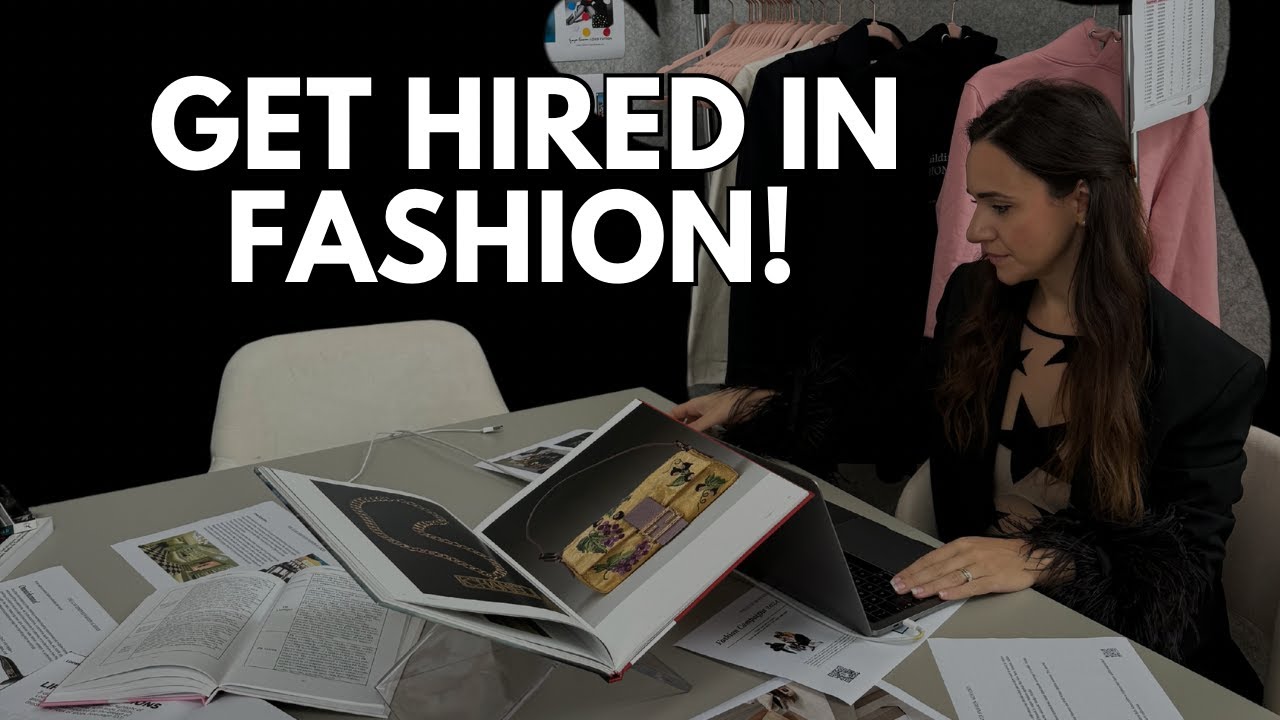
Watch this video or keep reading!
Why Your Fashion CV Matters More Than Ever in 2026
The average fashion job or internship receives around 500 applications. Recruiters spend roughly three seconds deciding whether a CV deserves a second look — and in 2026, that three seconds is harder to survive than ever before.
AI tools have made it easy for anyone to generate a polished-sounding CV in minutes. The result is that recruiters are now reading hundreds of applications that look and sound exactly the same — same structure, same buzzwords, same “passionate about fashion and eager to contribute” phrasing.
This creates both a problem and an opportunity.
If your CV looks generic, it disappears instantly. But if it is well-structured, tailored, and shows real proof of your thinking, it stands out immediately.
A strong fashion CV in 2026 is not just a list of what you have done. It is proof that you already understand how fashion jobs work.
What Fashion Recruiters Actually Look At First
When a recruiter opens your CV, they are not reading it. They are scanning it.
In three seconds they decide: does this person look right for this role?
That decision is based almost entirely on visual impression — the layout, the structure, whether key information is immediately visible. The actual content comes second.
This matters especially in fashion, an industry that judges presentation as a direct signal of taste, attention to detail, and professionalism. A cluttered or poorly formatted CV communicates the wrong things before a recruiter has read a single word.
The first rule of writing a fashion CV: your format is not secondary to your content. It is part of your content.
How to Structure a Fashion CV
Keep it to one page
For internships and entry-level fashion roles, your CV must fit on a single page. This is not a suggestion — it is what recruiters expect from candidates at the beginning of their careers.
A two-page CV from someone with limited experience signals poor editing judgment, which is itself a red flag in an industry where concision and attention to detail are essential. If you are struggling to fit everything, the answer is not to shrink the font. It is to cut anything not directly relevant to the specific role you are applying for.
Use a clean, professional template
Your CV template should be visually polished but easy to scan. Think clean columns, clear hierarchy, consistent fonts, and enough white space that the recruiter’s eye knows exactly where to go.
Avoid overly decorative templates with heavy graphics, icons everywhere, or strong colored backgrounds that make the document harder to read. In fashion, subtle creativity is rewarded — but legibility always comes first.
Tools like Canva have clean templates to start from. Inside the Break Into the Fashion Industry course, I also share CV templates built specifically for fashion applications.
Always save and send as a PDF
Never send your CV as a Word document. Formatting shifts across devices and software versions, and what looks perfect on your screen may appear completely broken on the recruiter’s. PDF preserves your layout exactly and is the professional standard expected by fashion companies.
What to Include in a Fashion CV
Contact information and links
At the top of your CV include: your name, a professional email address, your city, your LinkedIn URL, and — crucially in 2026 — a direct link to your portfolio if you have one.
A short professional headline
Directly under your name, write one or two lines that tell the recruiter exactly who you are and what you are looking for. Think of it as the first impression before the first impression.
Example: Marketing graduate seeking a fashion internship in luxury brand communication. Strong interest in campaign strategy and editorial storytelling.
Tailor this line to every single application. It takes two minutes and immediately signals that your application is not generic.
Education
If you are at the start of your career, your education section carries significant weight. Include the institution, degree, graduation date, and any relevant coursework, projects, or academic achievements.
Do not just list the degree title. Use bullet points to show what you actually studied and produced. If your degree included courses in digital marketing, brand management, trend analysis, or consumer behavior — list the relevant ones. If you completed a thesis or project with industry relevance, describe it specifically.
If you have completed online fashion courses with a certificate — including those from Glam Observer Academy — list them here too. What separates a strong application from a weak one at this stage is how you expand those entries.
Instead of writing:
Break Into the Fashion Industry Course – Glam Observer Academy
Write it like this:
Break Into the Fashion Industry – Glam Observer Academy
(Month Year)
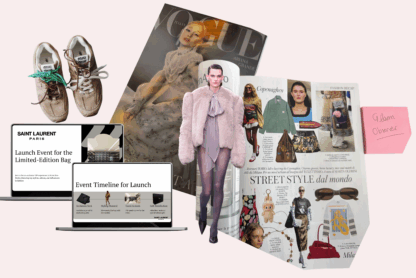
- Developed a 360° retail activation strategy for Saint Laurent Rive Droite, including event concept, target audience, and KPI projections
- Created a PR launch strategy for Miu Miu x New Balance: influencer seeding list, outreach timeline, and press contact structure
- Conducted competitor analysis on Gucci and Prada campaigns to identify positioning opportunities
The second version tells a recruiter exactly what skills you applied and what kind of thinking you are capable of — before you have had a single official job in fashion.
Work experience
List your experiences in reverse chronological order, most recent first. For each role, include the company name, job title, dates, and three to five bullet points describing what you actually did. Start each bullet point with an action verb and be specific rather than vague.
If you have no fashion experience yet, do not panic.
Any experience that demonstrates transferable skills — project management, data analysis, customer service, communication, event coordination — is worth including when framed correctly.
The key is connecting those skills to what fashion roles actually require.
If you have completed portfolio projects through the Fashion Internship Simulator, list them as experience entries using the same format shown above. Recruiters respond to proof of work regardless of how it was produced.
Skills
List your skills concisely — both hard skills and soft skills, keeping the latter brief and specific rather than generic.
Skills that appear consistently across fashion internship and entry-level job descriptions: Microsoft Excel, PowerPoint, Adobe Suite, Fashion GPS, social media platforms, content creation tools, Google Analytics, and any languages beyond your native tongue.
Excel deserves special mention. It appears in the majority of fashion job descriptions across buying, merchandising, marketing, operations, and even PR roles.
When I interviewed for my first internship at Alexander McQueen, I was given an Excel test during the process. My students are still being tested on it in 2026. If you have not learned it yet, start now — it is one of the fastest ways to make yourself more competitive on paper and in interviews.
Portfolio link
In 2026, a portfolio is often more powerful than the CV itself. If you have one, link it clearly in your header and reference specific projects within your bullet points as clickable links. More on this in the next section.
The Most Important Rule: Tailor Every Application — and Make It Interactive
Sending the same CV to every company is the fastest way to get ignored, and it is the mistake I see most often.
Fashion companies use Applicant Tracking Systems or AI tools that scan CVs for the specific keywords mentioned in the job description. If your CV does not reflect their language, it may never reach a human recruiter at all.
Here is a practical method that works: split your screen. Job description on one side, your CV on the other. Go through the job description and highlight every skill, tool, responsibility, and keyword. Then check your CV — does it reflect that language where it genuinely applies? Update it before every application.
For example, if the role mentions:
- influencer campaigns
- market analysis
- competitor research
- fashion event coordination
Those exact terms should appear in your CV where relevant.
But tailoring goes beyond keywords. In 2026, you also need to prove every skill you claim.
AI tools have made it easy for anyone to generate a polished-sounding CV in seconds. Recruiters know this.
A nice layout and well-written sentences are no longer enough on their own. What makes a CV credible now is evidence — every skill backed by a concrete example from a project, course, or real experience.
Instead of writing:
“Strong knowledge of fashion marketing”
Show the proof:
Fashion Marketing Project – Brand Collaboration Strategy
- Developed a global PR launch plan for a hypothetical Miu Miu x New Balance collaboration
- Identified key influencers and created a seeding timeline across European and US markets
- Conducted competitor analysis of sneaker collaborations from luxury brands
And do not just list a course name. Turn it into a real experience entry:
Break Into the Fashion Industry – Fashion Internship Simulator
- Created a retail activation concept for Saint Laurent Rive Droite to launch a limited-edition bag
- Planned influencer guest list and press outreach strategy for a VIP launch event
- Designed a post-event digital amplification strategy for Instagram and TikTok
Now here is the step most candidates are still missing in 2026: make your resume interactive.
Instead of just describing projects, add clickable links directly inside your bullet points — to portfolio PDFs, presentation slides, campaign concepts, or editorial projects.
For example:
Retail Activation Project – Saint Laurent Simulator
- Designed immersive in-store activation concept → [view project]
When a recruiter clicks and immediately sees your actual work, your application becomes significantly more powerful than the hundreds of text-only CVs in their inbox.
You stop being a list of claims and become someone with a visible body of work.
In today’s hiring landscape, proof always wins over claims.
Do this for every single application. Create a separate folder for each brand — CV, cover letter, portfolio — tailored to that specific role. It takes longer, but it is the difference between being in the 2% who get interviews and the 98% who do not.
What Not to Include in a Fashion CV
Knowing what to leave out is just as important as knowing what to put in. Remove these from your resume before sending any application:
Irrelevant jobs. Babysitting, restaurant work, supermarket jobs — unless they demonstrate a directly transferable skill, they take up space that should go to fashion-relevant content.
Generic skill claims. “Good communication skills,” “team player,” “passionate about fashion” — these phrases appear on every CV and add nothing. Replace every one of them with specific evidence.
References or “references available on request” — this is assumed by every recruiter and wastes valuable space.
An objective statement focused on what you want rather than what you offer. Recruiters care about what you bring to them, not what you hope to gain from the role.
How to Write a Fashion CV With No Experience
The most common fear I hear from students is: “My CV will be too short. I have nothing to put on it.”
Here is what I tell them: the problem is not that you have nothing. The problem is that you have not yet turned what you do have into the right format.
Here is what you can build your CV around even before your first internship:
- Your degree and relevant coursework, expanded with specific bullet points showing what you studied and produced.
- Academic projects, thesis work, or university assignments with industry relevance.
- Portfolio projects you have created independently — campaign concepts, editorial mock-ups, brand strategy exercises.
- Courses and simulators that produced real deliverable projects with certificates. Any fashion events, student publications, or industry organizations you were involved in.
When these are presented with specific detail, action verbs, and links to the actual work, they read as real experience. Because in every way that matters to a recruiter, they are.
If you want structured guidance building these kinds of projects, that is exactly what the Fashion Internship Simulator is designed for. You step into real roles — marketing assistant, PR assistant, stylist assistant, editor-in-chief — and produce portfolio-ready work that belongs on a professional CV.
Fashion CV Checklist Before You Send Any Application
Before hitting send on any application, run through this list:
- Does it fit on one page?
- Is it saved as a PDF?
- Is the layout clean and easy to scan in three seconds?
- Have I tailored it to the specific job description?
- Does it include the keywords from this specific job posting?
- Are my bullet points specific, starting with action verbs?
- Have I removed everything irrelevant to this specific role?
- Have I backed up every skill claim with a concrete example?
- Is my portfolio linked in the header?
- Have I added clickable links to project work inside the bullet points?
- Have I proofread it at least twice?
If yes to all eleven, send it.
If you want to learn more tips on what to do and not to do when applying for fashion jobs and internships check out this free pdf guide.
Fashion CV: Frequently Asked Questions
What is the difference between a fashion CV and a fashion resume?
In most of the world — including Europe, the UK, and internationally — CV and resume mean the same thing and are used interchangeably for job applications. In the US, resume is the standard term while CV typically refers to a longer academic document. For fashion jobs at international luxury brands, both terms refer to the same one-page application document described in this guide.
How long should a fashion CV be?
One page. For internships and entry-level fashion roles, a single-page CV is not just acceptable — it is expected. Recruiters in fashion receive hundreds of applications and a two-page CV from a candidate with limited experience signals poor editing judgment and a lack of concision.
How do I write a fashion CV with no experience?
Focus on your education expanded with detailed bullet points, transferable skills from non-fashion work, and portfolio projects you have created independently. Structured programs like the Fashion Internship Simulator give you real deliverable projects — campaign strategies, PR plans, editorial concepts — that you can list on your CV as genuine work experience before your first official job in fashion.
What keywords should I include in a fashion CV?
Always mirror the specific keywords in the job description you are applying for — this is what gets you past Applicant Tracking Systems. Beyond that, skills that appear consistently across fashion job postings include: Excel, PowerPoint, Adobe Suite, Fashion GPS, influencer campaign management, market analysis, competitor research, and social media strategy.
Should I send my fashion CV as a PDF or Word document?
Always PDF. Word documents shift formatting across different devices and software versions. PDF preserves your layout exactly as designed and is the professional standard expected by fashion recruiters worldwide.
Can I add online courses to a fashion CV?
Yes — and you should. List them in your education section and expand them with bullet points describing the specific projects you completed and skills you applied. A course entry with detailed bullet points reads as real work experience to a recruiter. A bare course name with no supporting detail tells them nothing useful.
What is the best format for a fashion CV?
A clean, single-column or two-column layout saved as a PDF. Use a legible font, clear section headings, consistent spacing, and enough white space to make it easy to scan. Avoid heavy graphics, colored backgrounds, or decorative elements that reduce readability. In fashion, the CV itself should demonstrate your eye for clean, professional presentation.
Do fashion companies use ATS to screen CVs?
Yes. Most luxury brands and larger fashion companies use Applicant Tracking Systems to screen applications before a human recruiter ever sees them. This means your CV must include the specific keywords from the job description to pass the initial scan. Tailoring your CV to each role is not optional — it is the minimum requirement to be seen.
The CV Is the Starting Point, Not the Whole Strategy
A great CV alone will not get you a fashion job in 2026. It is the essential starting point, but fashion recruiters are increasingly looking for candidates who go further — who reach out directly to hiring managers, who have portfolios that prove their thinking, and who demonstrate initiative before they are ever hired.
The candidates who break into fashion are not always the ones with the most polished CVs. They are the ones who understand how the industry works and show it at every stage of their application.
If you want the complete step-by-step strategy — including how to build your portfolio, write your cover letter, approach fashion companies directly, and prepare for interviews — that is exactly what the Break Into the Fashion Industry course covers.
And if you want to understand the most common mistakes candidates make on their fashion CVs — and how to fix each one — read this next: 5 Most Common Resume Mistakes in Fashion.
Stop applying blindly. Start applying strategically. Here is the link to my 1-hour free webinar, where you’ll learn the 3-part application framework that top candidates use to stand out among 500+ applicants, even without experience or connections.
Because the goal is not just a great CV. The goal is the job.