
I always say that breaking into fashion has never been easy, but 2026 is shaping up to be one of the most competitive years for entry-level applicants. Not because there are fewer opportunities, but because the applicants themselves are changing. Fashion students are more informed. Career changers are more prepared. Almost everyone has access to the same templates, the same information, and the same tools.
When I look at the applications students send me for review inside the Glam Observer Academy, I notice something new. They are cleaner. More organized. Better structured. Even the average student now knows how to build a simple CV, write a short paragraph on LinkedIn, and put together a basic portfolio using Canva.
Which brings us to the real question.
If everyone already knows the basics, then what will truly make you stand out in 2026?
That is what I want to talk to you about today, because the things that made candidates stand out in 2018, 2020, or even 2023 are not the same things that will matter moving forward. The fashion industry is evolving, and so are recruiters’ expectations. And if you want to walk into 2026 with the confidence of someone who knows they will have a chance, this is the moment to prepare.
So let’s look at what will really differentiate you in an industry where everyone seems to be doing the same things.
Why standing out is harder than ever (and why it is not your fault)
A lot has changed. Let me walk you through some of the things I see every single day.
More students are graduating from fashion schools than ever before.
But that also means more people have the same degree.
Everyone uses Canva CV templates.
But that means recruiters receive hundreds of resumes that look identical.
LinkedIn has become a key part of the application process.
But now that everyone updates their profile, simply having one is no longer special.
Most students now know that they should write a cover letter.
So cover letters, even if basic, have become common.
And let’s be honest.
AI tools have made writing these documents much smoother. They have also made everything feel a little more… similar.
So if you feel like it is getting harder to stand out, you are right. But you are not behind. You are simply living in a moment where the game is changing, and the people who learn how to stand out intentionally will have the advantage.
Because fashion recruiters will no longer be impressed by the basics.
In 2026, they will expect more.
What fashion recruiters will look for in the 2026 applicant
Let’s break down exactly what will matter, because it is not what many people think.
1. Skill-based candidates, not theory-based ones
Fashion companies want people who can do things, not just talk about them.
This means that having a degree, no matter how prestigious, will not be enough. What recruiters want is evidence.
Evidence that you can build a PR list.
Evidence that you understand sample management.
Evidence that you know how to prepare a retail activation.
Evidence that you can coordinate an editorial.
Evidence that you understand how to analyze sales or read product performance.
If you want to show a recruiter that you can do the job, you need proof. A simple sentence like “I understand PR” does not mean anything unless you show a real PR launch plan. This is exactly why we created the new course The Fashion Internship Simulators, so you can do assignments like in a real office but from home, that you can show to recruiters.
In 2026, proof will matter more than statements.
2. Create a role before it exists and show initiative with portfolio-ready projects
This is my favorite unconventional advice.
Choose a brand you love and create something for them without being asked.
A project. An idea. A report. A concept.
For example:
- a micro-trend report after Paris Fashion Week
- a TikTok content idea for their next drop
- a potential showroom guest list
- a visual merchandising refresh
- an Excel analysis of their best-selling categories
- a PR event concept
- a simple capsule styling idea
Then send it directly to the brand with a short message.
You will impress them more than any resume alone ever could.
No one does this.
Which is why those who do stand out immediately.
Companies do not want people who wait to be told what to do. They want people who anticipate.
So if you apply for a marketing internship, recruiters will want to see something you created. A content idea. A small competitor analysis. A moodboard. A report. Something that shows you did not wait for someone to hire you before acting like part of the industry.
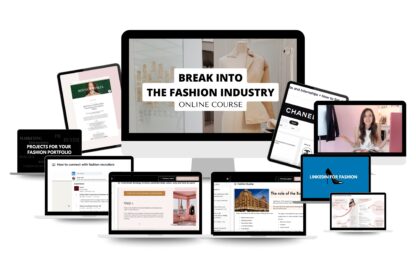
This is something I teach deeply inside Break Into the Fashion Industry and The Fashion Interships Simulator. Building your own experience before someone gives you experience is what makes the difference.
And again, it is not about perfection. It is about showing you are already thinking like someone inside the industry.
3.Become findable, not just hireable
Recruiters now search on LinkedIn the same way we search on Google or ChatGPT ;).
This means your profile must be optimized like SEO.
Use clear keywords in your headline, skills, and About section:
- Fashion Marketing Assistant
- PR Intern
- Merchandising Assistant
- Excel for Fashion
- Trend Analysis
- Sample Management
- Fashion Portfolio
- Brand Activation
You want to appear in recruiter searches automatically.
LinkedIn recently announced that the algorithm rewards meaningful conversations and topic authority. So do not just post a nice photo.
Comment, engage and create content that reflects your specialty.
This is subtle. But incredibly powerful.
I teach how to use LinkedIn in my Break into the Fashion Industry Course.
4.Candidates who understand the business side of fashion
This is the biggest shift I am seeing. Creativity will always matter in fashion, but creativity alone is no longer enough. Fashion has become more analytical, more data-influenced, more structured. Teams rely on reports, dashboards, trackers, analyses, forecasts, and numbers.
This is where so many applicants are still unprepared.
Let’s talk about Excel for a moment
Excel remains one of the most important tools in fashion. From PR assistants managing guest lists, to buyers analyzing product performance, to e-commerce teams tracking daily sales. Almost every intern and every assistant uses Excel. Not knowing how to use it is the difference between feeling confident during your internship or overwhelmed.
During my interview at Alexander McQueen, they surprised me with an Excel test. It was not written in the job description. And yet that test was what got me hired. If I had not known Excel, my career would have started very differently. Inside Excel for Fashion, I teach the exact formulas, tools and case studies used in the industry. This course was born from my own experience.
In 2026 Excel will still be a must to know.
And now let’s talk about AI
AI is transforming the industry in ways that students don’t fully realize yet.
Teams are now using AI for:
- trend analysis
- drafting reports
- forecasting
- content research
- operational tasks
- workflows and productivity
The young candidates who already know how to integrate AI into their work will move faster, deliver more, and catch the attention of recruiters.
This is why I am building the new course AI for Fashion, a short but powerful program that shows how to use AI professionally in fashion tasks. It is not just about ChatGPT. It is about using AI in a strategic, elegant way that supports your role and increases your value inside a team.
In 2026, the competitors who understand AI will quietly win.
5. Get recommendations before being hired
This is one of the most out-of-the-box tips you can ever give.
People think recommendations come after you get a job.
But you can get micro-endorsements even before that.
Ask:
- a professor who saw your initiative
- a mentor who guided you
- a brand you helped with a small task
- collaborators from student projects
- volunteer or freelance contacts
Even a short, one-sentence testimonial becomes powerful proof of your professionalism.
It shows reliability, consistency, and character in a way your CV cannot.
The invisible skills that will matter in 2026
Now let’s talk about the real secret.
The qualities that truly make recruiters think:
This person is different.
These are things you do not learn in school.
They are the behaviors that turn an intern into someone a team wants to hire permanently.
They include:
- Confidence navigating systems
- Understanding how to learn fast
- Initiative without waiting for instructions
- Anticipating the needs of the team
- Organization that keeps you from making mistakes
- Accuracy and attention to detail
- Being solution-oriented instead of panicking
And yes, these skills come from experience. But they also come from familiarity.
When students go through our Internship Simulators, they already know the rhythm of fashion tasks. They know how to think, how to prepare, how to approach a task calmly. So when they start their first internship, they feel at home. And the team feels it too.
These invisible skills are quietly becoming the most important differentiators.
The biggest differentiator of all: initiative
Let me tell you something I wish someone told me in my early twenties.
The candidates who land the best internships are not always the ones who are the most talented. They are the ones who start preparing before they feel ready.
In 2026, the candidates who stand out will be the ones who:
- Build portfolio projects before they have experience
- Learn Excel before the interview surprises them
- Practice outreach before the perfect job is posted
- Create a small project before applying to a brand
- Prepare a resume that is personalized instead of generic
- Write a cover letter that actually speaks to the brand
- Use AI intelligently to work faster
- Update their LinkedIn with intention
- Choose not to wait
- Choose to start
This is what initiative looks like.
And initiative is one of the most valuable skills in fashion.
What you can start doing now to stand out in 2026
Here is how you can begin today:
- Create one small portfolio project
- Learn the Excel basics you will actually use in fashion
- Start building your AI literacy
- Prepare a personalized CV for one dream role
- Write a clear LinkedIn headline
- Send your first cold email
- Review your resume with the eye of a recruiter
- Learn the structure of a real cover letter
- Build a simple project that proves your skills
- Start gathering references from brands you admire
- And most importantly, do not wait for the perfect moment
Preparation is what separates the applicants who get overwhelmed from the ones who get hired.
So if you want to start preparing for 2026 intentionally, this is the moment.
I always say that Glam Observer exists because I didn’t have anyone to show me the real path when I was starting out. Everything I learned, I learned the hard way. And I created these programs so you don’t have to.
Here is what will be included:
Break Into the Fashion Industry
If you want to build a strong resume, a persuasive cover letter, a real portfolio, and learn exactly how to reach out to recruiters the right way.
Excel for Fashion
If you want to master the skill that 90 percent of fashion internships actually require.
The Fashion Internship Simulators
If you want real projects to add to your CV and confidence before your first internship.
You can stand out in 2026. Truly.
The industry may feel competitive, but there has never been a better moment to enter fashion. The opportunities are there for those who prepare in the right way.
And standing out is not about perfection.
It is about clarity.
It is about initiative.
It is about building skills that others are not thinking about yet.
It is about showing who you are, not just what you studied.
If you start preparing today, the confidence you will walk into 2026 with will feel completely different.
And I cannot wait to see you there.