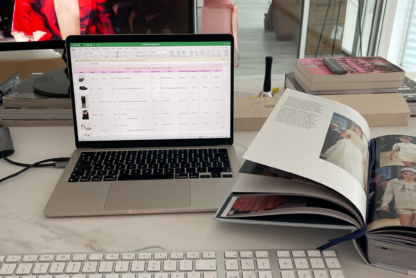


Yesterday, I started creating a new sheet to organize the data of the students inside the Glam Observer Academy. It’s the same file I first created in 2018, but this time I added a new tab: 2026.
I paused for a second because I couldn’t believe it. It’s almost been ten years since I launched Glam Observer and created the very first version of Break Into the Fashion Industry. Over the years, the course has been updated again and again to reflect how the industry evolves. And 2026 marks one of the biggest shifts I’ve ever seen.
People often ask me whether things have changed since I broke into fashion myself. The answer is yes and no.
Yes, the tools, hiring processes, and expectations have changed dramatically. But the core principles of what makes someone hireable in fashion have remained surprisingly consistent.
As the founder and head of education at Glam Observer, fashion hiring is my daily bread. I review applications constantly, analyze job descriptions, speak with recruiters, follow hiring trends across cities and roles, and most importantly, I speak with you. You tell me what recruiters ask during interviews, which tests you’re given, where you feel stuck.
Over the years, I’ve worked with thousands of students: people without a fashion degree, graduates from top schools like FIT, Istituto Marangoni, and London College of Fashion, career switchers, and complete beginners. I’ve seen every possible starting point.
That’s why in this article, I want to break down what hiring in fashion really looks like in 2026 and how you can prepare to stand out in a world where applications are increasingly built with AI. If you want, you can go and watch my YouTube video where I’ll explain how to get a fashion job in 2026, step by step.
Why AI-built applications are becoming a problem in fashion hiring
One of the biggest shifts happening quietly in 2026 is the mass use of AI to build resumes, cover letters, and job applications.
On paper, it sounds like a smart solution. Faster applications. Perfectly written sentences. Optimized keywords.
In reality, it’s creating a serious problem.
Fashion recruiters are now reading hundreds of applications that look and sound exactly the same.
The same structure.
The same buzzwords.
The same “passionate about fashion and eager to contribute” sentences.
AI has made it easier to apply, but it has flattened individuality. And in an industry like fashion, sameness is dangerous.
What I see more and more is this: candidates rely on AI to do the thinking for them instead of using it as a support tool. The applications are technically correct, but emotionally empty and strategically weak. There is no point of view. No specificity. No real understanding of the brand.
And recruiters can spot this immediately.
The irony is that AI is supposed to help you stand out, yet when used improperly, it does the opposite. It makes you blend in. When everyone uses the same tools in the same way, differentiation disappears.
This is especially risky at entry level. When recruiters receive hundreds of applications that all sound polished but identical, they filter more aggressively. They look for anything that feels human, intentional, and real. A specific reference to a collection. A personal insight. A project that shows thinking rather than wording.
In 2026, knowing how to use AI is not optional. But knowing how not to use it is what will protect your career.
The candidates who will break into fashion are not the ones who let AI speak for them. They are the ones who use it strategically: to refine, not replace; to structure, not standardize; to save time, not erase personality.
This is why, if you use AI, you need to learn how to use it like a recruiter, not like a shortcut. Tools like Fashion Recruiter in a Pocket – 60 ChatGPT Prompts exist precisely to help you guide AI strategically: to analyze job descriptions, pressure-test your CV, and refine your thinking without erasing your personality.
Fashion has always rewarded originality.
And no algorithm will ever replace that.
So how do you stand out in an AI-generated job market?
You stand out by doing what AI can’t do.
The end of the CV-only application era
There was a time when submitting a resume was enough to get noticed in fashion. Years ago, that was the main gateway.
Even when I first created Break Into the Fashion Industry, I taught my students to go beyond the CV. But in 2026, this is more important than ever.
Today, we don’t want to build an average application. Average applications disappear. And first impressions matter more than people realize. You will be remembered for how you apply. A strong application doesn’t just help you land a role. It sets the tone for how you’re perceived inside the company and even influences future promotions.
AI has made resumes more polished, but also more uniform. When everything looks perfect, perfection stops being impressive.
Cover letters still matter, but the format is evolving
Cover letters are still important, but in 2026, I strongly encourage my students to add a video cover letter.
I didn’t use one when I broke into fashion years ago, but my students who do use it get job interviews around 30 percent faster than those who don’t.
It’s simple: a one-minute video, like an elevator pitch. In an AI-driven world where anyone can generate a written cover letter in seconds, recruiters struggle to assess communication skills, clarity, and personality.
A video cover letter restores trust.
When everything else feels automated, seeing and hearing a real person immediately humanizes your application. It shows confidence, clarity, and intention in a way no AI-written paragraph can.
Expect more tests and practical evaluations
Because AI can generate answers, employers are leaning more heavily into:
- Skills tests
- Work samples
- Structured interviews
- In-person or higher-trust interview formats
We’re entering a “bots versus bots” era. Candidates use AI to optimize applications, while employers use AI to screen them. The result is an arms race where writing quality matters less than proof.
What differentiates candidates now is not prettier wording, but demonstrated skill.
Customization is no longer optional
A few years ago, a perfectly polished generic application could still impress some companies. That era is over.
Today, polished applications are everywhere. People use AI to write cover letters, emails, and even LinkedIn messages. Most of them do it the wrong way.
Generic applications don’t stand out anymore, even when they’re beautifully written. Customization is no longer a “nice to have”. It’s the baseline.
Customizing your resume, cover letter and portfolio to fit the position is super important.
Portfolios are no longer just for designers
Everyone says:
“I’m passionate about fashion.”
“I’m detail-oriented.”
“I’m eager to learn.”
The candidates who stand out show:
- A project they created
- A decision they made
- A problem they solved
In 2026, proof beats phrasing.
That’s why portfolios and project-based experience now matter for marketing, PR, editorial, and business roles too. Internship-style projects, like those inside the Fashion Internship Simulators, allow you to show how you think and work even before getting hired.
AI can generate words.
It cannot fake logic or execution.
Stop waiting for experience and start creating it
One of the most damaging beliefs I still hear is: “I can’t apply because I don’t have experience yet.”
No one in fashion starts with experience. Experience is built, not given.
The candidates who break into fashion in 2026 stop waiting for permission. They start acting like professionals before they’re hired.
Fashion companies no longer hire potential alone.
They hire proof.
Use AI as a tool, not as your voice
The smartest candidates do use AI. But you can’t see it.
- Analyze job descriptions
- Identify missing signals
- Pressure-test their CV
- Improve clarity, not personality
They never submit raw AI output.
If a recruiter could say, “This sounds like ChatGPT,” you lose.
If there’s one thing I want you to take away from this article, it’s this:
breaking into fashion in 2026 is not about luck, connections, or having the “perfect” background.
It’s about strategy.
We are living in a moment where the barriers that once felt impossible are lower than ever. You can build experience before getting hired. You can learn the exact skills fashion offices use. You can understand how recruiters think. And you can position yourself globally, even if today you feel far from the industry.
Yes, AI has changed the rules. BUt not so much.
If you want to go deeper, I invite you to start with my free webinar, where I walk you step by step through how recruiters really hire in fashion today and what you need to do to become the kind of candidate they want to interview.
From there, you can choose the path that fits you best:
- Break Into the Fashion Industry, if you want a complete, structured roadmap to land your first job or internship in fashion
- Excel for Fashion, if you want to build one of the most in-demand skills recruiters test and expect
- Fashion Internship Simulators, if you need real, portfolio-ready projects to prove your experience
- Fashion Recruiter in a Pocket – 60 ChatGPT Prompts, if you want to learn how to use AI the right way, without sounding generic or replaceable
You don’t need to have everything figured out today.