

I hear this question all the time: should I do a fashion course or focus on getting an internship?
Most people are stuck because they believe a course is necessary in order to get an internship. But here is the real catch: the internship is the experience they need to get the experience that internships require. You need experience to get experience, and nobody tells you how to break that circle.
So let’s break it down properly.
First, Let’s Break the Biggest Myth: You Do Not Need a Fashion Degree to Work in Fashion
Before we even get into courses versus internships, I want to address something that comes up in almost every conversation I have with students, and it is holding a lot of people back.
The belief that you need a fashion degree to work in fashion.
Think about it this way. The only industries where you absolutely need to have studied that specific subject are medicine, engineering, and law. Obviously you cannot become a doctor without studying medicine. But fashion is not one of these industries.
Some of my friends studied law and became buyers. Many of my students studied history, art, or communications and now work in fashion marketing. Most fashion buyers and merchandisers I know do not have a buying or merchandising degree, but studied economics. And most stylists? They have an innate sense of style and visual thinking that no school gave them.
When I got my first job at Kering, I walked in expecting my colleagues to have all come from fashion schools, after all, we are talking about one of the world’s biggest luxury groups, and in that office I was working alongside the teams of Saint Laurent, Balenciaga, Brioni… But nobody had a fashion degree. Most fashion graduates end up in design departments. Everywhere else in the business, the industry hires people with traditional degrees in economics, communications, management, marketing, and beyond.
So if you are thinking about doing a master’s in fashion because you believe your current degree would not be enough for the industry, let me be honest with you: that is not a good reason to do it.
I always tell my students this: if you want to do a fashion course because you genuinely love the subject, the lessons excite you, and you want that specific knowledge, yes, do it. Education is never wasted when it is done for the right reasons.
But if you are doing it because you believe a fashion degree will magically open the doors of the industry, it will not. And here is something that surprises people when I say it: inside my Break Into the Fashion Industry course, around 70% of my students are fashion graduates from top fashion schools. They went through the degree, they got the diploma, and they are still stuck trying to figure out how to actually get hired. A degree alone, no matter how prestigious the school or how expensive the master’s, without the right strategy, portfolio, and application approach, will not get you hired any faster than someone without one.
I teach fashion courses myself, so I am not about to tell you education is useless. What I can tell you is that what the industry actually values is often different from what you expect. When I interviewed for Alexander McQueen, the recruiter told me directly that they were not particularly impressed by my master’s in luxury and fashion management that was listed on my CV. Do you know what impressed them? Some smaller online courses I had taken on my own initiative. Why? Because those courses, which cost a fraction of my master’s and took far less time, told the recruiter something my degree could not. They showed initiative. They showed a proactive mindset. They showed real, self-directed passion for the industry backed by action.
Society almost imposes on us the idea that a degree and a master’s are the path. But those extra online courses I had taken showed the recruiter that I was not waiting for an institution to hand me knowledge, I was going out and getting it myself. That mindset is what the industry values. It is exactly why I structured Glam Observer Academy the way I did, everything I teach comes back to what the industry actually rewards, based on my own real experience inside it.
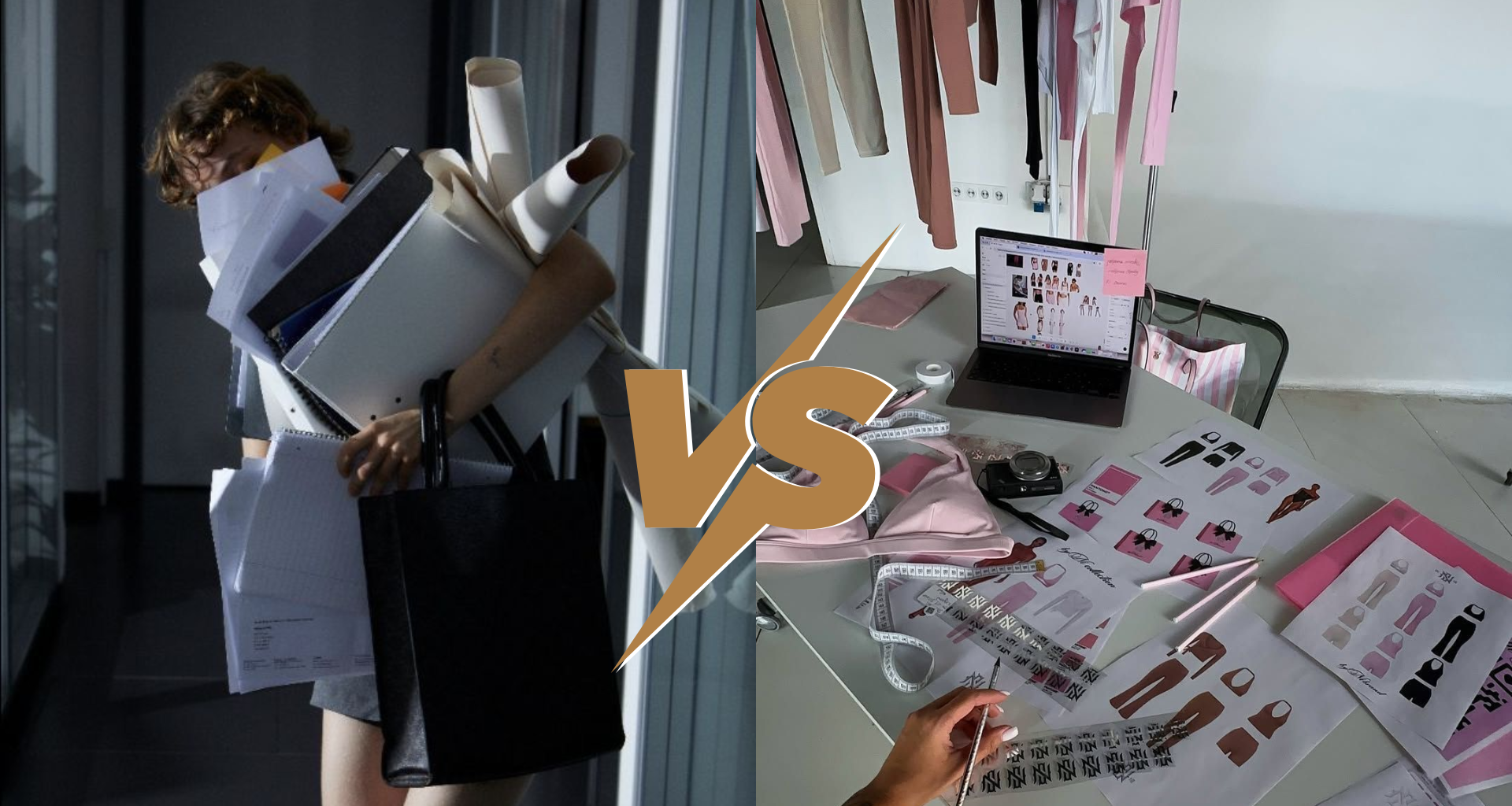
So let’s start comparing fashion internships vs fashion courses and which will help you get hired.
What a Fashion Internship Actually Gives You
A fashion internship is genuinely valuable. I want to be clear about that before anything else.
When I got my internship at Alexander McQueen, it changed everything. It gave me real industry exposure, contacts, and the kind of context you simply cannot get from reading about fashion. I understood how a fashion office actually runs,the pace, the tools, the culture, the unwritten rules. I learned real skills: how a fashion company operates, how to work with Excel under pressure, how to communicate with senior team members, how to move inside a creative environment that also operates as a serious business, how everything changes during fashion week seasons…
A fashion internship is also, simply put, your first real work experience in the industry. And I do not know a single person who broke into fashion and went straight into a full-time role without going through internships first — unless they were already senior professionals switching industries. If you spent five to ten years as a marketing manager at a company like Amazon and you are moving into fashion at the same level, then yes, you don’t need internships. But if you are at the beginning of your career, internships are not optional. They are the path, and a course won’t help you skip them.
This is important to understand because it completely changes how you think about courses. A course — even the one from the most prestigious school — is not a substitute for an internship. It never will be. What a course can do is get you ready for the internship, make your application strong enough to actually get one, and give you proof of skills that puts you ahead of other candidates. But the internship itself is still the goal. It is still the experience that opens the doors to everything that comes after.
So even if you complete the most prestigious master’s in fashion management, you will still need to do internships to break into the industry. That is not a flaw in the system, it is how fashion works. The degree gives you knowledge and context. The internship gives you the lived experience and that first line of real fashion work on your CV that everything else builds on.
Beyond all of that, a fashion internship also helps you understand what is actually made for you.
If you are undecided between two or more career paths, doing internships will give you that clarity faster than anything else. You might think you want to work in PR and discover after two months that buying is where you actually come alive. You might dream of editorial and realise you are more energised by the commercial side.
Many people start with a very clear idea of their dream career, and completely change their mind the moment they step inside the industry because the reality was different.
So yes, a fashion internship is valuable. Deeply valuable. The question is not whether to do one indeed. The question is what you need in place before you can realistically get one.
What a Fashion Course Gives You, and What It Doesn’t
I did a Master’s in Luxury and Fashion Management in Milan. I loved it. Being surrounded every day by people who lived and breathed fashion, working on projects with brands, attending industry events, it gave me incredible context and energy.
But I also noticed something during that time, and even more clearly once I started working inside fashion companies: a lot of fashion education is theoretical. You learn the history, the concepts, the frameworks. What you often do not get is preparation for the actual tasks you will face on your first day at work, how to build a sell-through analysis in Excel, how to structure a PR seeding strategy, how to brief a shoot, and how to write a cold outreach message to a hiring manager.
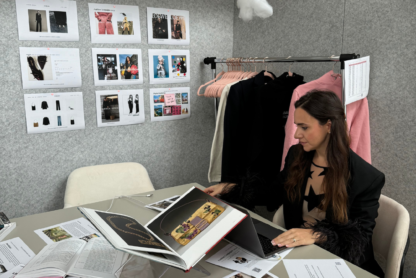
That gap between fashion education and fashion reality is exactly why I built my courses the way I did. The Fashion Internship Simulator came from exactly that thinking: what if students could practice the real tasks of a marketing assistant, a PR assistant, a stylist, or an editor-in-chief before they ever set foot in an office? So that when they arrive, they are not starting from zero, they already know how the work feels.
A good fashion course gives you structured practical knowledge, not just theory, but the real day-to-day tasks of the roles you want to apply for. It gives you portfolio projects you can show recruiters, real work that tells a recruiter far more than a blank CV with a list of skills and no evidence behind them. And it gives you confidence in interviews. When a recruiter asks, “Have you worked on a launch campaign before?” and you have actually built one, even as a simulation, you have a real answer.
What a fashion course does not give you is the lived experience of working inside a brand, real industry contacts, or that first official internship line on your CV.
So Which One Should You Choose?
Let me give you a clear answer for each situation you might be in.
Get experience as soon as possible, even while studying. This is the single most important piece of advice I can give you. Even if you decide to do a course or a degree, intern whenever you can, during the course, during summer, on weekends if possible. When you graduate, you will already be ahead of the majority of other graduates competing for the same positions. Recruiters appreciate real experience above almost everything else on a CV, and the earlier you start building it, the better.
Choose a course when you genuinely want to be in that learning environment,in classes with other students, meeting fashion professors, building knowledge that excites you. Not because you believe that school will automatically place you inside the industry, and not because you think an expensive master’s will do the work for you. Choose it because you want the knowledge and the experience of studying something you love.
If you are applying for internships and not getting results, it’s easy to assume you need more—more courses, more certifications, another line on your CV. And yes, learning new skills, building connections, and having tangible projects to show can absolutely strengthen your profile. But here’s the part most people overlook: a course alone won’t fix the problem if the real issue is how you are applying.
Many times, it has nothing to do with your degree or whether you studied fashion or not. I’ve seen fashion graduates and non-fashion students struggle in the exact same way. The difference is rarely what’s on paper, it’s how that paper is presented. In an industry where recruiters receive hundreds of applications, sending a generic CV or portfolio simply won’t get you noticed.
So the real question becomes: are you positioning yourself in a way that makes recruiters see your potential immediately?
Because if right now you don’t have a portfolio, or your CV doesn’t reflect fashion-specific skills, then yes, building those assets is essential. You can figure it out on your own. Everything is technically available online. But what I’ve noticed after years of mentoring students is that when you try to piece it all together alone, you often miss the industry insights that actually make the difference. You end up guessing, overthinking, or worse, spending months applying with the same strategy that isn’t working.
And time matters more than you think. The longer the gap, the harder it becomes to explain why you haven’t yet broken into the industry.
This is why having a clear roadmap changes everything. Not because you couldn’t do it by yourself, but because it helps you focus on what actually moves the needle: building the right kind of portfolio, crafting applications that feel intentional, and positioning your profile like someone who already belongs in the industry.
At some point, it stops being about learning more about fashion and starts being about learning how the hiring process in fashion actually works. What recruiters look for, how they scan applications, what makes them say yes in those first few seconds. That’s the kind of knowledge that changes your results, because it transforms the way you apply, not just what you know.
That is exactly the gap the Break Into the Fashion Industry course was built to close. Not to teach you more about fashion as a subject, but to teach you how to break into it. The strategy, the application, the positioning, the portfolio. Everything a recruiter actually needs to see, structured in a way that makes sense for where you are right now.
What Are the Best Types of Fashion Courses to Take?
Based on my experience inside fashion companies and everything I have seen working with students, there are three types of courses that actually move the needle:
Practical skill-based courses: these are courses that teach you a concrete, specific skill that fashion professionals actually use day to day. Look at your dream role, study the job descriptions carefully, identify the skills that come up repeatedly, and go learn those. Not fashion theory, practical, applicable knowledge that you can demonstrate from your first day in a fashion office.
The best example of this in fashion is Excel. It sounds unglamorous, but if you look at almost any fashion job description, buying, merchandising, marketing, retail operations, supply chain, and even PR, it appears consistently. Fashion teams use it daily to analyse sales data, track product performance, plan budgets, and build reports. When I interviewed for my first internship at Alexander McQueen, I was given an Excel test during the hiring process. My students are still being tested on it in 2026. Learn Excel applied to fashion with the Excel for Fashion Course.
Application strategy courses: Learning how to apply for fashion jobs is just as important as learning fashion itself, if not more.
You can have the right degree, the right skills, and still get ignored if you don’t know how to position yourself.
This is where most people get stuck.
Because the problem is rarely what you know, it’s how you translate that into a CV, a portfolio, and an application that makes a recruiter stop and pay attention.
The right kind of course here doesn’t just teach you more about fashion. It teaches you how to approach the job search strategically, how to tailor your applications, and how to present your experience in a way that feels relevant, even if you’re just starting out. Take a look at the Break into the Fashion Industry Course here if you want this type of course.
Real task practice: instead of learning about fashion theory, you are actually doing fashion work. You complete real tasks, the kind that professionals execute inside fashion offices every day, and you produce real outputs that go directly into your portfolio and onto your CV. Think about what this means in practice. Instead of studying what a PR assistant does, you build an actual influencer seeding strategy for a real brand brief. Instead of reading about editorial, you plan and produce a full magazine issue. Instead of learning the theory of retail activations, you develop one from brief to execution. You walk away with work you can show, explain, and defend in an interview, because you actually did it. The Fashion Internship Simulator is exactly this kind of course.
Fashion Internship vs Fashion Course: Frequently Asked Questions
Is a fashion internship or a fashion course better for getting a job?
Neither is universally better, it depends on where you are right now. If you have no portfolio or fashion-specific experience yet, a practical course that builds real projects is usually the faster path to getting internship offers. If you already have some foundation, focusing on internship applications makes sense. Most people who break into fashion quickly do both, in the right order.
Can a fashion course replace a fashion internship?
A fashion course cannot fully replace an internship because it does not give you real industry contacts, the lived experience of working inside a brand, or the chance to discover what kind of fashion role is truly right for you. But a practical course can replace the need to have an internship before your first internship, meaning it gives you enough proof of skills and portfolio work to compete for positions without prior experience.
Do fashion companies care about online courses?
Yes, if the course produced real portfolio projects and you present them correctly on your CV. A course listed as a bare entry with no supporting detail adds very little. The same course expanded with specific bullet points describing the projects you completed, campaign strategies, PR plans, and editorial concepts, reads as genuine work experience to a recruiter.
How do I get a fashion internship with no experience?
Build portfolio projects first. Recruiters at luxury brands are not expecting entry-level candidates to have worked at five companies,but they do expect to see evidence that you understand the job. Self-initiated projects, course simulations, and structured programs like the Fashion Internship Simulator give you that evidence before your first official role.
What is the Fashion Internship Simulator?
The Fashion Internship Simulator is a structured program inside Glam Observer Academy that puts you through real fashion industry tasks, the same kinds of projects that marketing assistants, PR assistants, stylists, and editorial teams work on inside luxury brands and magazines. You complete real deliverables, build a portfolio, and finish with experience entries you can add directly to your CV.
Should I do a fashion course before applying for internships?
If you currently have no portfolio and your CV has no fashion-specific content, yes, doing a practical course before applying will significantly improve your results. If you already have relevant projects to show, start applying and use a course to strengthen specific skills alongside your search.
Why is fashion education often too theoretical?
Most traditional fashion degrees and masters programmes focus on industry history, brand strategy frameworks, and academic analysis, which is valuable context, but does not prepare you for the practical tasks you will face on your first day in a fashion office. Having done a Master’s in Luxury and Fashion Management myself, and having worked inside fashion companies, I saw this gap clearly. It is exactly why I built the Fashion Internship Simulator, to give students the hands-on task practice that traditional fashion education rarely provides.
Ready to Break Into Fashion?
If this article helped you get clarity on where to start, here is where to go next.
If you want to understand the full strategy,how to build your application from scratch, and approach fashion companies in a way that actually gets responses,join my free masterclass: 3 Powerful Strategies to Break Into the Fashion Industry. It is the same method I used to land my own internship at Alexander McQueen, and that thousands of Glam Observer students have used to get jobs at brands like Dior, Condé Nast, Prada, and more.
If you are ready to go deeper,with step-by-step guidance on your CV, cover letter, portfolio, and interview preparation,the Break Into the Fashion Industry course covers everything in full.
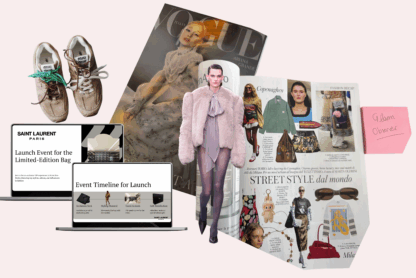
If you want to build real portfolio projects before your first internship,the Fashion Internship Simulator puts you inside four real fashion industry role simulations, Marketing Assistant at Saint Laurent and Miu Miu, Assistant Stylist at Vogue Italia, and Editor-in-Chief, so you have actual work to show recruiters and real stories to tell, even if you have never worked in fashion before.