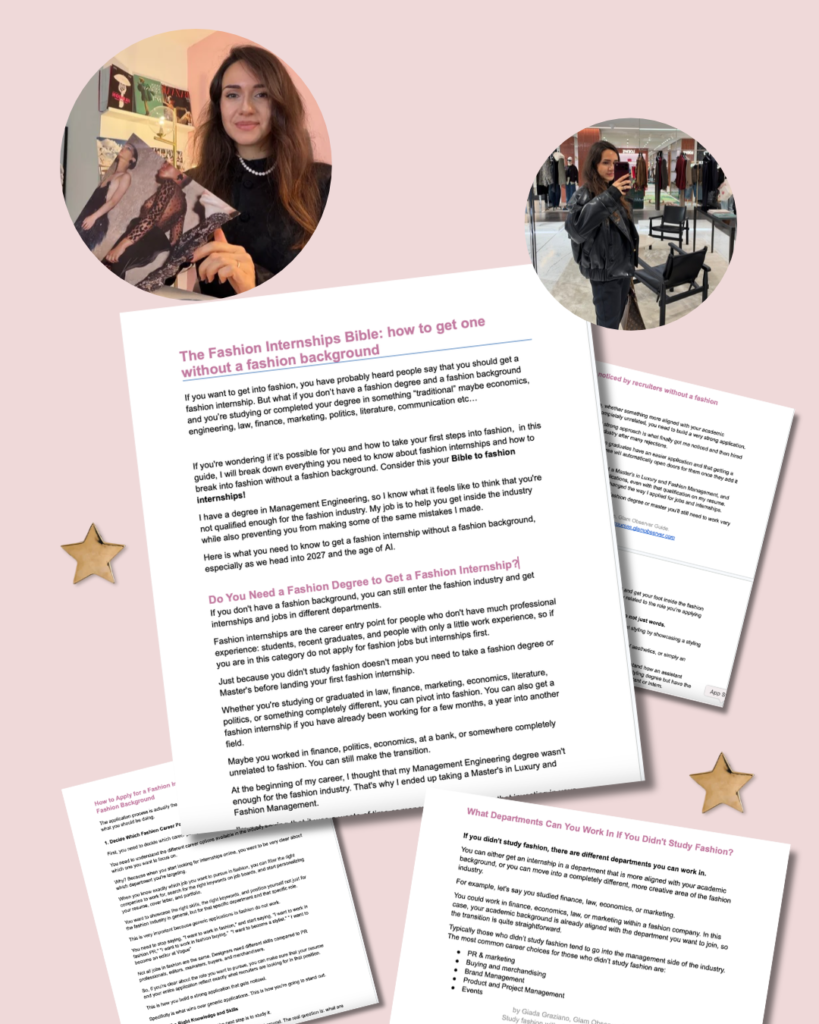



If you want to get into fashion, you have probably heard people say that you should get a fashion internship. But what if you don’t have a fashion degree and a fashion background and you’re studying or completed your degree in something “traditional” maybe economics, engineering, law, finance, marketing, politics, literature, communication etc…
If you’re wondering if it’s possible for you and how to take your first steps into fashion, in this guide, I will break down everything you need to know about fashion internships and how to break into fashion without a fashion background. Consider this your Bible to fashion internships!
I have a degree in Management Engineering, so I know what it feels like to think that you’re not qualified enough for the fashion industry. My job is to help you get inside the industry while also preventing you from making some of the same mistakes I made.
Here is what you need to know to get a fashion internship without a fashion background, especially as we head into 2027 and the age of AI.
Do You Need a Fashion Degree to Get a Fashion Internship?
If you don’t have a fashion background, you can still enter the fashion industry and get internships and jobs in different departments.
Fashion internships are the career entry point for people who don’t have much professional experience: students, recent graduates, and people with only a little work experience, so if you are in this category do not apply for fashion jobs but internships first.
Just because you didn’t study fashion doesn’t mean you need to take a fashion degree or Master’s before landing your first fashion internship.
Whether you’re studying or graduated in law, finance, marketing, economics, literature, politics, or something completely different, you can pivot into fashion. You can also get a fashion internship if you have already been working for a few months, a year into another field.
Maybe you worked in finance, politics, economics, at a bank, or somewhere completely unrelated to fashion. You can still make the transition.
At the beginning of my career, I thought that my Management Engineering degree wasn’t enough for the fashion industry. That’s why I ended up taking a Master’s in Luxury and Fashion Management.
I’m not saying that it was a waste of time or money because I believe that investing in your education is never the wrong investment, especially when you’re investing in the right resources. However, I think it’s important to say that you can break into fashion directly with your traditional degree. You don’t necessarily need an additional fashion Master’s to get into the industry. Unfortunately at that time nobody told me that, so I am here for you now.
If you want to pursue a Master’s because you enjoy studying fashion and want to learn more about the industry, that’s totally fine. But don’t do it just because you think it’s your only option for getting into fashion.
You could take some online fashion courses to add fashion knowledge and industry-specific keywords to your resume, while showing recruiters your commitment to the industry. They are shorter and often cheaper.
Actually, when I interviewed for my e-commerce internship at Alexander McQueen, Yoox Net a Porter and Kering, the recruiter told me that she was more impressed by my online fashion courses than by my Master’s in Luxury and Fashion Management.
Why? Because those short online courses truly demonstrated my interest in the fashion industry and my initiative. Recruiters are used to receiving resumes from graduates of top fashion schools. Having a Master’s degree isn’t necessarily what impresses them the most. But if you show initiative and demonstrate a proactive mindset, that’s how you’re going to stand out.
They appreciated that I was constantly learning about fashion outside of my Master’s, alongside my studies.
They noticed my online courses because most people simply take their Master’s degree and stop there, instead I was still taking online fashion courses in parallel to my bachelor and master’s degree.
I was backing up my passion for the industry with true commitment.
What Departments Can You Work In If You Didn’t Study Fashion?
If you didn’t study fashion, there are different departments you can work in.
You can either get an internship in a department that is more aligned with your academic background, or you can move into a completely different, more creative area of the fashion industry.
For example, let’s say you studied finance, law, economics, or marketing.
You could work in finance, economics, law, or marketing within a fashion company. In this case, your academic background is already aligned with the department you want to join, so the transition is quite straightforward.
Typically those who didn’t study fashion tend to go into the management side of the industry. The most common career choices for those who didn’t study fashion are:
- PR & marketing
- Buying and merchandising
- Brand Management
- Product and Project Management
- Events
- Supply Chain
- Finance
- Law
- HR
- Journalism
But you can also pivot completely. Let’s say you studied economics, finance, or marketing, but now you want to work in styling, PR, art direction, or another creative area of the fashion industry. You can absolutely do that, too.
You can change career paths and move into a department that isn’t necessarily aligned with what you studied.
For example, I studied Management Engineering and ended up working in e-commerce.
I wouldn’t say that my e-commerce internship was completely unrelated to my degree because it was still a management-related role within a fashion company. However, it wasn’t exactly a traditional Management Engineering role within a fashion business, either.
So, just remember: there isn’t one single rule or one single path to getting into fashion. You can either pivot into a completely different department or choose something that is more aligned with what you studied. Both options are possible.
When you’re at the beginning of your career, recruiters aren’t necessarily going to look at your degree and immediately dismiss you because you studied something unrelated to fashion. That’s not what they’re going to focus on.
Instead, they want to see other qualities, attitudes, and mindsets that demonstrate you have the potential to be trained and become great at your job.
How do you get noticed by recruiters without a fashion background?
Whatever path you choose, whether something more aligned with your academic background or something completely unrelated, you need to build a very strong application.
Using an unconventional and strong approach is what finally got me noticed and then hired by the top companies of the industry after many rejections.
Many people believe that fashion graduates have an easier application and that getting a Master’s degree or a fashion degree will automatically open doors for them once they add it to their resume.
But, as I mentioned earlier, I also got a Master’s in Luxury and Fashion Management, and companies were still ignoring my applications, even with that qualification on my resume. Things only started changing when I changed the way I applied for jobs and internships.
So even if you decide to then pursue a fashion degree or master you’ll still need to work very hard on your applications.
There are different ways to demonstrate your potential and get your foot inside the fashion industry, even if your academic background isn’t directly related to the role you’re applying for.
- Show your passion with projects and a portfolio not just words.
For example, you can demonstrate that you could be great at styling by showcasing a styling portfolio.
You can show that you have an eye for style, a natural sense of aesthetics, or simply an understanding of how the industry works.
If you want to get a styling internship demonstrate that you understand how an assistant supports a stylist during a project or on set. You might not have a styling degree but have the organizational skills that stylists are looking for when hiring an assistant or intern.
You can build this portfolio from home with projects that you “invent” or if you prefer to follow a plan, enroll in something like The Fashion Internships Simulator where you’ll be guided step by step.
It’s the same thing that my student Kyo did. He enrolled in the internships simulator and got at Vogue, the team was very impressed by his understanding of the industry despite not having had a job yet!
Focus on the Company and the Position, Not on You
After helping over 5,000 people and spending more than 10 years as a fashion mentor and educator, I can tell you that one of the most common mistakes I see people make when trying to break into fashion is focusing too much on themselves.
Here’s what it usually looks like. Cover letters that open with “I have always dreamed of working in fashion.” Resumes with a summary that says “Motivated graduate eager to learn and gain experience in the fashion industry.” LinkedIn messages that say “I would love an opportunity to start my career with you.”
Every one of these sentences is about you: your dream, your wish to learn, your need for a chance. And recruiters read hundreds of them every week.
It’s okay to be humble and to show that you’re willing to learn. But getting a fashion internship isn’t about a company doing you a favor. Companies hire interns because they need help. A team has a launch coming up, a showroom to prepare, samples to track, a sell-through report due every Monday. Your job is to show them you can lighten that load.
So before you write anything, ask yourself three questions:
- What does this team actually need? Read the job description and list the tasks. That’s what they’re struggling to get done right now.
- What is the company going through right now? A new creative director, a store opening, a new category, a big campaign. Show that you’ve noticed.
- What can I already do that helps? A project, a course, a skill, a past experience from your “non-fashion” life.
Then rewrite your sentences around the answers.
Instead of:
“I am passionate about fashion and eager to learn everything about PR.”
Write:
“I noticed your team manages press and celebrity seeding for three collections a year. I’ve already built an influencer seeding list and a sample tracking sheet for a Miu Miu launch project, so I’d be able to support your sample flow from day one.”
Instead of:
“I’m a finance graduate looking for my first opportunity in fashion.”
Write:
“My finance background means I’m comfortable analyzing data, and I’ve completed Excel for Fashion , so I can help your merchandising team prepare weekly sell-through reports.”
Notice what changed. Your background didn’t change. Your experience didn’t change. What changed is that every sentence now answers the recruiter’s real question: how will this person help us?
I learned this myself during one of my early interviews. Instead of talking about how much I loved the brand, I mentioned that I had subscribed to their newsletter and noticed a broken link in it. A tiny detail. But the recruiter remembered it, because it showed I was already paying attention to their business, not just dreaming about working there.
That’s the switch from “me” to “them.” And it’s often the difference between the application that gets ignored and the one that gets a call.
- Add some online fashion courses
The quickest way to add something related to fashion on your CV is with online fashion courses. This allows you to adornate your resume with fashion related keywords.
A recruiter reading a resume full of law, finance or engineering might wonder: does this person really understand fashion, or is this just a phase? A few targeted fashion courses answer that question before they even ask it.
But not every course will do the job. The ones that make a difference are the ones aligned with the role you’ve chosen, and the ones that leave you with something to show. A course name alone on your CV doesn’t say much. A course with bullet points describing the real projects you completed tells a recruiter far more.
For example, instead of writing only:
Fashion Internship Simulator – Glam Observer
you could write:
Fashion Internship Simulator – Glam Observer
- Developed a PR launch strategy for a Miu Miu collaboration, including an influencer seeding list and press outreach plan
- Translated a moodboard into three editorial looks for a Vogue Italia shoot and built a sample tracking sheet
Then add a hyperlink to each project so the recruiter can open it in one click. Now the course isn’t just a line on your resume. It’s proof.
This is exactly how I built the courses inside Glam Observer Academy, starting from what I wish I’d had when I was the girl with a Management Engineering degree trying to convince fashion companies to take her seriously:
- If you want to practice the job before you have the job, the Fashion Internship Simulator puts you inside real projects as a Marketing Assistant at Saint Laurent and Miu Miu, Assistant Stylist at Vogue Italia, and Editor-in-Chief. You walk away with portfolio pieces and resume bullet points like the ones above. It’s what my student Kyo did before he got in at Vogue.
- If you’re aiming for buying, merchandising, marketing or management, Excel for Fashion teaches you the spreadsheets fashion offices actually use, and the ones you’ll likely be tested on in your interview. I took an Excel test for my first internship, and my students are still taking them today.
- And if you want the complete jobs search strategy, from choosing your role to building your resume, cover letter and portfolio and finding the opportunities most people miss, Break Into the Fashion Industry walks you through every step.
Whichever path you choose, the principle is the same: don’t just say you love fashion. Show the recruiter you’ve already started investing in it.
Want to learn how to apply step-by-step without a fashion background, including resume, cover letter and portfolio tips? This article was becoming too long so I shared more tips in this FREE GUIDE that you can download here!