


If you want to get your first fashion internship in 2026, you need to understand how the industry really works today.
This week, the trailer for The Devil Wears Prada 2 was released.
And like many of you, I immediately felt that familiar spark.
That movie was the reason so many of us fell in love with fashion in the first place. Not just the clothes, but the idea of working in a creative office, being surrounded by inspiring people, moving fast, feeling part of something bigger.
For me, it was my sign.
The moment I realized I wanted a career in fashion, not just a passion on the side.
When people think about fashion internships, they still picture Andy from The Devil Wears Prada.
Running errands.
Getting coffee.
Doing tasks that feel random and disconnected from real work.
And if you don’t know anyone working in fashion yet, that image might still be your reference.
But that version of internships belongs to the past.
The reality of fashion internships today is very different.
And if you want to get your first fashion internship in 2026, you need to understand how the industry really works now.
If you want, I’ve talked about this on my YouTube channel:
How Fashion Internships Actually Work Today
The role of the intern has completely changed.
Today, interns are not hired to observe.
They are hired to contribute.
When I did my first fashion internship at Alexander McQueen ( e-commerce internship), I never made coffee. Not once.
From day one, I worked like everyone else in the company. Same tools, real responsibilities, real deadlines.
And this is now the standard for most companies. Fashion companies expect interns to be useful quickly. Which means one thing: they expect you to know some things already before you even start.
Why Fashion Internships Feel So Intense Now
Many students tell me:
“It feels like companies want employees but pay them less.”
I understand why it feels that way.
But even if you work the same hours as a junior employee, your experience level is not the same. Someone who has done the job for years works faster, more independently, and with fewer mistakes.
Despite this, Interns are no longer hired to “learn slowly.”
They’re hired to be useful almost immediately.
That’s why what companies look for in interns has changed.
Everyone assumes you already know how things work.
For years, we were told that passion and creativity would be enough.
They’re important, but they’re not enough.
Fashion companies hire people who can contribute already.
If you’ve applied for fashion internships recently, you’ve probably noticed this.
Job descriptions of fashion internships asking for:
- Experience
- Technical skills
- Tools
- Excel
And you might think:
“Why would they expect this from an intern?”
Because interns already contribute to the team.
That’s why companies have moved from hiring based only on CVs to hiring based on skills and assessments.
I was tested on Excel during my interview at Alexander McQueen.
And my students get tested today.
The recruiters focused more on what I could do than my Master in Luxury and Fashion Management.
They also tested my second language.
All signs that companies are looking for people who can do things already from day one.
If you look at what people share on Glassdoor, you’ll see this is now very common. Assessments are especially used for internships, because a senior professional is already expected to know tools like Excel.
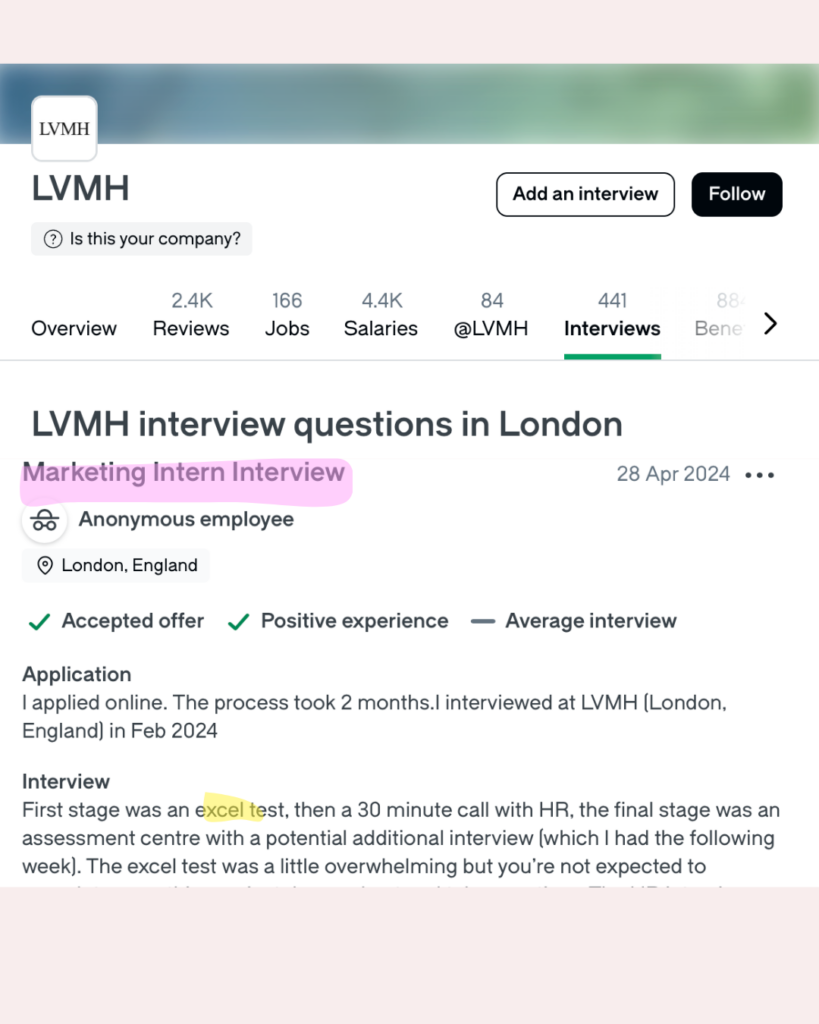
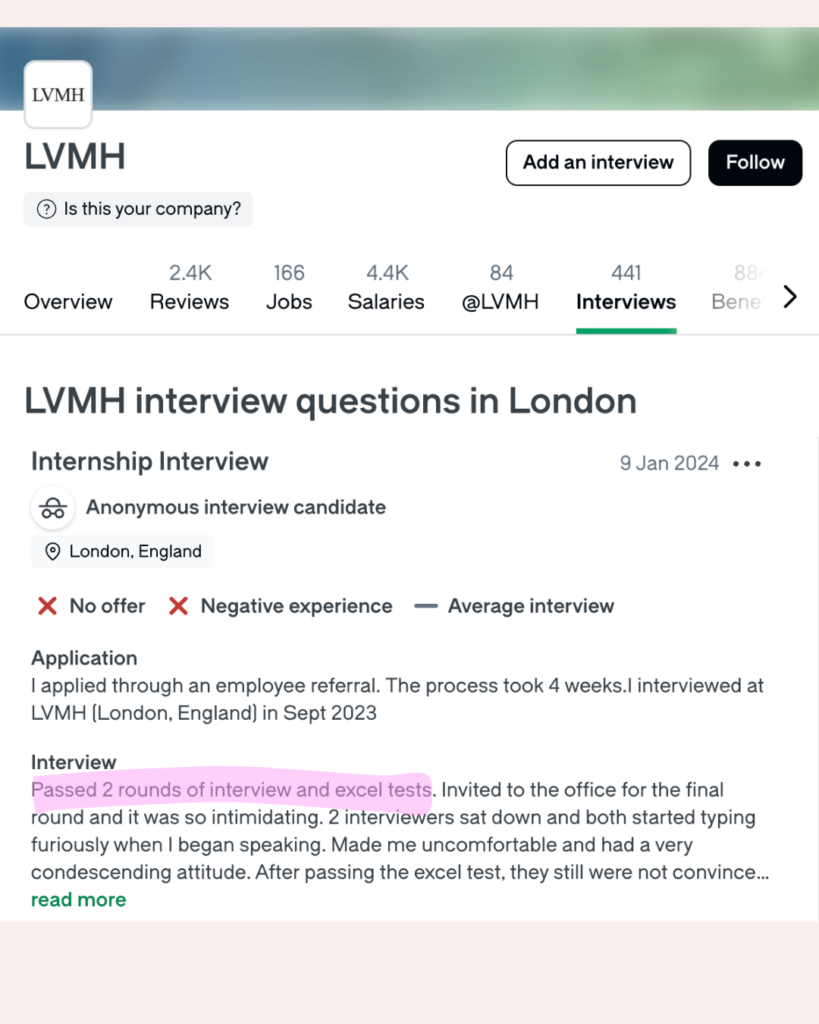
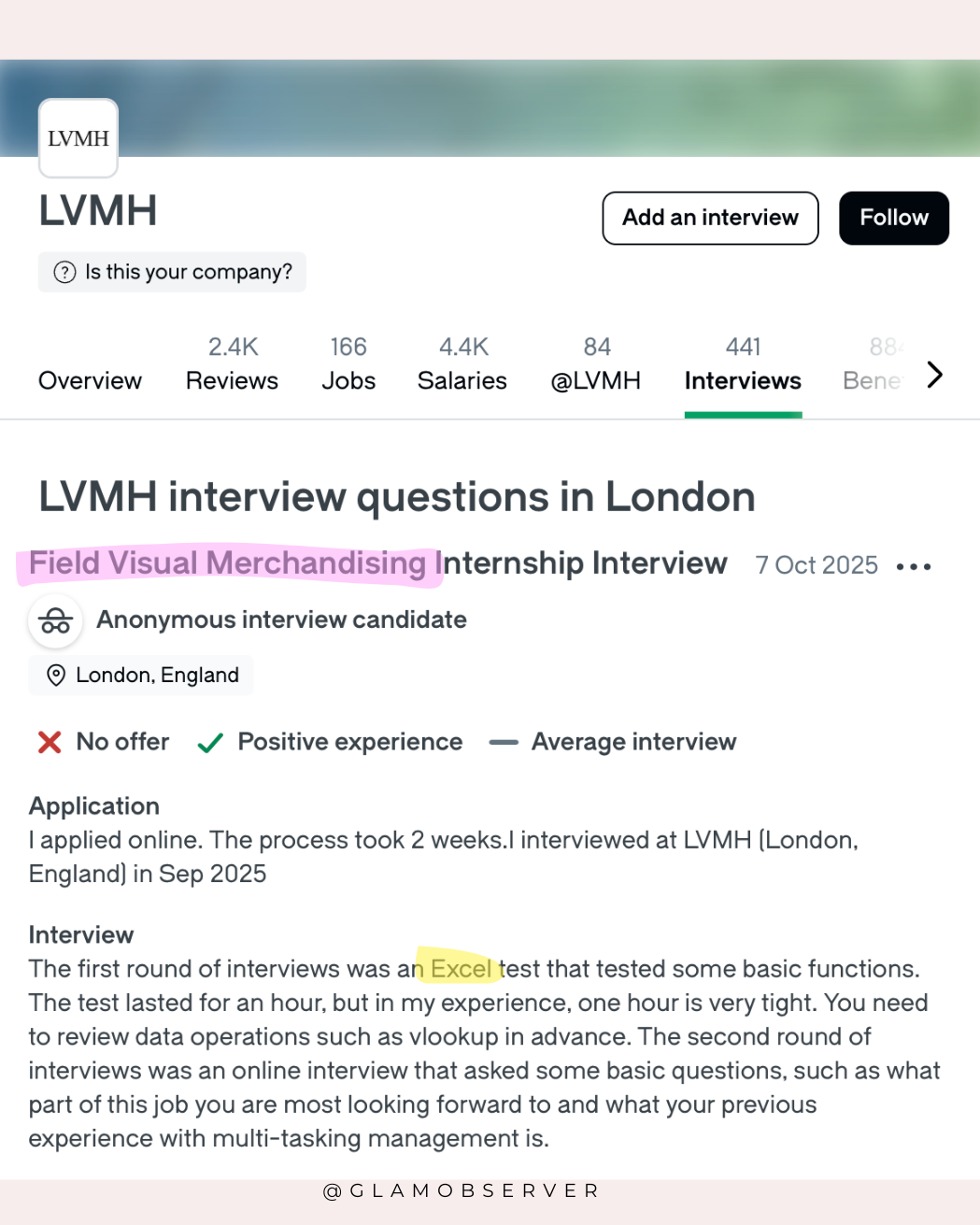
And because these companies are so competitive, they can for sure find at least one candidate who is going above and beyond just their degree and who has that spark and that mindset. And I want that candidate to be YOU.
And honestly? I think this system is much fairer.
How many times did you feel you deserved a job but didn’t get it because you didn’t have the “right” degree?
Recruiters don’t really care about your degree.
They care about what you’ve learned and whether you can contribute to the team.
And that’s good news because skills can be acquired, and you can become the smart candidate they are looking for.
It’s About Turning Skills Into Proof
This is the key shift you need to understand.
Getting a fashion internship is not about listing skills on your CV.
It’s about turning a skill into something tangible.
Something you can actually use on the job.
Something you can show.
That’s why, if you want to get a fashion internship in 2026, you should stop focusing only on writing a “perfect” CV or cover letter.
Instead, focus on acquiring skills and showing companies that you have them.
Start by reading job descriptions for your dream fashion internships. Look at what skills are required again and again. Then go and learn those exact skills.
The Microsoft Office package is often listed in job descriptions, but please don’t underestimate it.
This is a very common mistake.
Many people assume that when companies ask for “good” or “proficient” Excel skills, their school-level knowledge is enough.
It’s not.
Excel is seriously required in fashion.
And it’s often tested during interviews.
Fashion professionals use Excel daily to track samples, analyze sales, plan launches, manage reports, and organize campaigns.
This is why I run a free live Excel webinar, where I show exactly how Excel is used in fashion and what recruiters actually test for.And if you want to go deeper, my Excel for Fashion course teaches Excel specifically for fashion roles, so you’re not learning random formulas, but skills you’ll really use on the job.
So What Can You Do Now to Get a Fashion Internship?
Let’s make this very practical.
If you want to get a fashion internship in 2026, stop focusing only on writing the perfect CV and start focusing on proof.
Here’s what actually works:
Learn real skills.
Read job descriptions for your dream roles and look at what keeps coming up. Those are the skills you need to focus on.
Take Excel seriously.
Excel is not optional in fashion. It’s one of the fastest ways to look professional and useful from day one.
Build a portfolio.
Even if you’re not applying for a creative role. Your portfolio can include simulations, case studies, reports, or projects that show you understand the job.
When you combine skills + Excel + a portfolio, your application changes completely. You stop looking like a beginner and start looking like someone ready to work.
How Do You Show Proof Without Experience and How to Build Experience Without Experience
This is the question I get asked the most:
“If I don’t have experience, how can I prove myself?”
By simulating the job.
This is exactly why I created the Fashion Internships Simulator.
It allows you to:
- Simulate real fashion internships
- Understand what different roles actually do day to day
- Build real projects you can add to your portfolio
You don’t just learn theory.
You create tangible proof that recruiters can see.
And that’s what gets interviews.
The Real Secret to Getting Your First Fashion Internship
Getting into fashion is not about luck.
It’s not about connections.
And it’s not about waiting for someone to train you.
It’s about being ready.
Learn how the industry actually works today.
Build the right skills.
Master Excel.
Create proof through a portfolio.
That’s how you really get your first fashion internship.