

If you’re applying for your first fashion job and either don’t have a portfolio yet, or you have one but you’re not sure if it’s strong enough to actually pass the application stage, this article is for you. I’m going to walk you through the most common portfolio mistakes I see every single day reviewing the work of my Fashion Internships Simulator students, because a great portfolio can open you the doors to the fashion industry even if you don’t have experience and at the top luxury brands, but a poorly executed one can actually close them.
Having a portfolio nowadays is not a plus, but necessary if you want to stand out among all the other applicants. But your portfolio also has to be strong enough to convince recruiters and show the right skills. Otherwise, it doesn’t help your application — it hurts it.
Let’s get into it.
Why a Portfolio Matters More Than Ever in 2026
Before we talk about what’s going wrong in most portfolios, I want you to understand why the portfolio has become such a non-negotiable in fashion right now.
According to a recent industry analysis, only around 37% of employers in 2026 still see traditional credentials: degrees, job titles, bullet-point histories — as reliable signals of talent. Over 40% are actively moving away from resume-first hiring. Some have already replaced CVs with skills tests and portfolios entirely.
And this isn’t just tech. This is happening across creative industries, and fashion is right in the middle of it.
Between January and March 2026, I personally analyzed over 1,100 fashion internships and entry-level job listings posted by luxury brands, fashion companies, and media groups. What I found was that the most in-demand roles are no longer just the obvious creative ones. They are merchandising, planning, marketing, digital commerce, retail operations, and business analytics. And in every single one of these listings, recruiters were no longer asking only for “passionate candidates” — they were asking for proof that you can actually do the job.
Why has this happened? Because AI changed everything.
Recruiters are telling me every single week. They are now opening hundreds of resumes and cover letters that read identically. Same structure. Same phrases. Same polished tone. ChatGPT can generate a beautiful CV in 8 seconds. So the resume, on its own, has stopped being a reliable filter.
What recruiters are reaching for now is proof. Real proof of skills. Real proof of thinking. Real proof that the candidate understands the job before the job. And the document that delivers all three at once is the portfolio.
This is the moment to take it seriously.
Mistake #1: Not Having a Portfolio at All
I want to start with the most basic mistake because it’s still the most common one: not having a portfolio in the first place.
The majority of people I speak to believe a portfolio is reserved for designers, stylists, or “creative” careers. They think marketing assistants, PR coordinators, buyers, merchandisers, and editors don’t need one.
This is wrong.
A portfolio is not a moodboard collection. A portfolio is proof of your skills and your knowledge. It is the document that lets recruiters see what you can do without forcing them to guess it from your resume or your cover letter. It puts your work, your reasoning, your industry understanding directly in front of them.
If the word “portfolio” feels too tied to creative roles for you, call it something else. Call it a project deck. Call it a case study file. Call it a proof-of-skills document. The label doesn’t matter. What matters is that you have one.
Especially if you don’t have experience yet, this is the thing that lets you compete.
Mistake #2: Waiting to Have Experience Before Building One
This is the one I hear constantly. “But Giada, I don’t have experience yet — how can I build a portfolio?”
I’ll give you the answer in one sentence: you build the portfolio so you can get the experience. Not the other way around.
Yes, once you’re inside the industry, you’ll be able to update your portfolio with real projects from your real job. That’s wonderful. But waiting until then to start is the same as waiting to swim until you’re already in the ocean.
And I want you to understand something important: a strong portfolio built by someone without industry experience can actually be more impressive to recruiters than one built by someone with it. When recruiters see strong, structured, intelligent projects from a candidate who hasn’t worked in fashion yet, the first thing they think is: “Where did this person learn all this?” It signals curiosity, initiative, and a real effort to understand the industry before being paid to be there. That mindset is exactly what fashion companies are looking for in entry-level hires in 2026.
Gone are the days when interns were hired just to learn on the job. Yes, you will still learn enormous amounts on the job — but recruiters today want candidates who can contribute from day one, even in a small way. That’s the difference. A portfolio is how you show you’re ready to contribute.
Mistake #3: Recycling Old Projects Just to Have Something to Send
Now we move into the portfolios that exist but aren’t doing their job.
The most common version of this mistake is including old projects you did in school just to fill the pages. Maybe it was a marketing assignment from your bachelor’s degree. Maybe it’s a styling moodboard from a class three years ago. The work is there, technically, but it’s no longer aligned with the role you’re applying for today — or with the skills you’ve developed since.
Sometimes those projects don’t even reflect how you would do the work now if you started fresh. You’ve grown. You’ve learned. You’re a sharper version of yourself.
In that case, it’s actually better to send no portfolio than the wrong one. And it’s much better to start from scratch with one single new project that’s perfectly aligned with the role you’re targeting than to attach four outdated ones that confuse the recruiter or, worse, suggest you don’t quite understand what the role is about.
Less is more. A portfolio with one to two strong, focused, recent, role-aligned projects will always outperform a portfolio with ten unrelated ones.
Mistake #4: Building a Generic Portfolio Instead of a Role-Specific One
Now let’s move to the important part which is the content of your portfolio.
It’s not enough to have just any project in your portfolio. The project(s) you choose should show skills that are relevant for the role you want to pursue.
A fashion marketing portfolio is not the same as a fashion styling portfolio. A PR portfolio is not the same as a buying portfolio. A design portfolio is not the same as an editorial portfolio. The skills are different. The deliverables are different. The day-to-day tasks are different. So the portfolio has to be different too.
A fashion designer sketches. So of course their portfolio will include sketches. A fashion marketer will never sketch anything in their entire career — so a portfolio full of sketches is, frankly, useless for them.
The easiest way to figure out which projects to put in your portfolio is to do something I teach all my students: read the job descriptions of your dream fashion internships. Read the responsibilities section in particular. Inside every single responsibility there is a portfolio project waiting to be built.
Let me show you exactly what I mean with a real example.
Example: Building a PR Portfolio For Dior
Imagine I’m looking at a PR internship at Christian Dior. The job description says things like:
“Support the PR team across daily operations and ongoing processes. Assist with weekly and monthly clippings and reports on press coverage during fashion week and events.”
Right there, in that single bullet point, is your first portfolio project.
You can simulate this entire task at home. Collect every media feature talking about Dior after fashion week — every magazine article, every Instagram post from major fashion editors, every online review of the show. Organize them by publication, by reach, by audience. Build it into a polished PDF that mirrors the format of a real PR press report. That’s project number one.
Then the same job description says: “Assisting with regional and local sample send-outs and returns.”
Project number two. You build a sample management system — the kind PR teams use to track which celebrities, editors, and influencers received which pieces, with timelines, return dates, and condition checks. You don’t need access to real samples to do this. You can build it as a hypothetical case for a Dior collection that already exists.
That’s two portfolio projects pulled directly from one job description. Both of them show that you understand what a PR assistant actually does day to day. Both of them prove you can already think like someone in the role.
This is the difference between a portfolio that gets you interviews and one that gets ignored.
If you want to build portfolio projects guide step-by-step, check out the Fashion Internships Simulator.
Mistake #5: Adding As Many Projects As Possible
Once people understand the importance of having a portfolio, they often swing in the opposite direction and try to pack it with everything they’ve ever done.
But recruiters spend an average of 6 to 8 seconds on a resume, and only slightly more on a portfolio in their first scan. If your portfolio has ten projects and only two of them are strong, the eight weaker ones are diluting the two great ones. The recruiter doesn’t have time to dig for the gems.
You can absolutely have a longer master version of your portfolio with more work in it. But when you’re sending your portfolio with an application — especially for the first time, to a brand that doesn’t know you yet — send one or two of your strongest, most relevant projects. That’s it.
A trick I teach my students: in your resume, you can link to different portfolio projects from different sections. If a recruiter is interested in seeing more, they can click and explore. Maybe in your education section you link to a project you did in school. Maybe in your skills section you link to a competitor analysis you built independently. This way you give them options without overwhelming the first impression.
You don’t need ten projects to start applying. You need one really strong, well-structured, role-aligned project. That is genuinely enough to start landing interviews.
Mistake #6: Treating Design and Formatting Like an Afterthought
We are in fashion. The way you present your work matters as much as the work itself.
The most painful version of this mistake I see comes from Canva users — and I love Canva, this isn’t about the tool. It’s about how it’s being used. People drop their content onto a Canva template and then ignore the template structure. Text goes from the absolute left edge of the page to the absolute right edge with no margins. Three different fonts appear on the same page. Title sizes are inconsistent. Headers are aligned differently from one page to the next.
I want you to imagine your portfolio as a professional internal PDF report you’d be presenting to a luxury fashion company as a senior manager. How would you present that report? You’d use clean, simple fonts. You’d respect margins. You’d be consistent. You’d make sure every page felt like it belonged to the same document.
This matters especially in luxury, where attention to detail is paramount. The way you build the pages of your portfolio is itself showing the recruiter how you would build documents once you’re inside the company. If your portfolio is messy, the message you’re sending — without meaning to — is that you’ll be messy in your work too. That you rush. That you don’t notice the details.
Even if the actual content inside is brilliant, a chaotic layout will undercut it.
Mistake #7: Showing the Final Result Without the Process
This is one of the most underestimated mistakes, and probably the one that separates an okay portfolio from an excellent one.
Recruiters do not just want to see the final output. They want to see how you arrived at it.
When you present a campaign concept, why did you choose that concept? What research did you do? Which competitors did you analyze? What insights from the market shaped your direction? Why did you pick those colors, those influencers, those distribution channels?
When you present a styling project, why did you select those designers? How did your moodboard influence your final looks? What was the editorial point of view?
When you present a PR strategy, what made you target those particular publications and creators? What gap in the market are you addressing?
This is the thinking process. And the thinking process is what tells a recruiter whether you understand the work or whether you got lucky on one project. The final result might not even be perfect — that’s okay. The fact that you reasoned your way through it, researched, made deliberate choices, and can explain them, demonstrates multiple skills at once: strategic thinking, attention to detail, brand understanding, and professional maturity.
Show your work. Literally.
Mistake #8: Not Explaining What You Actually Did
Linked to the process mistake but slightly different: I often see portfolios where there’s clearly a project happening on the page — beautiful images, layouts, references — but no clear explanation of what the candidate actually did.
I open a page and I see editorial looks pulled together. Okay. But why? What was the brief? What was your role? What were you trying to demonstrate?
I open another page and I see a table with numbers. Is it a competitor analysis? A sales projection? A media planning grid? I shouldn’t have to guess.
Every page of your portfolio needs a clear short caption or paragraph explaining:
- What the project is about
- What the objective was
- What you specifically did
- What the outcome or concept is
For example, instead of just dropping a competitor table on a page, you write: “Competitor analysis comparing Chanel and Saint Laurent’s bag launch strategies for SS26. I looked at pricing, distribution windows, influencer activations, and content rollout to identify positioning gaps.”
Now the recruiter knows exactly what they’re looking at and what skills you demonstrated.
What Recruiters Actually Want to See in 2026
After years of mentoring thousands of students, watching them apply, and speaking constantly with hiring teams across luxury brands and fashion media, I can tell you exactly what is and isn’t working in 2026.
The students of mine who landed jobs and internships this year — at brands like Dior, Louis Vuitton, Prada, Saint Laurent, Condé Nast — were not the ones with the prettiest moodboards. They were not the ones with the most projects. They were not even the ones whose projects came from real work experiences.
They were the candidates whose portfolios proved, through structure and substance, that they understood the role and could do the job.
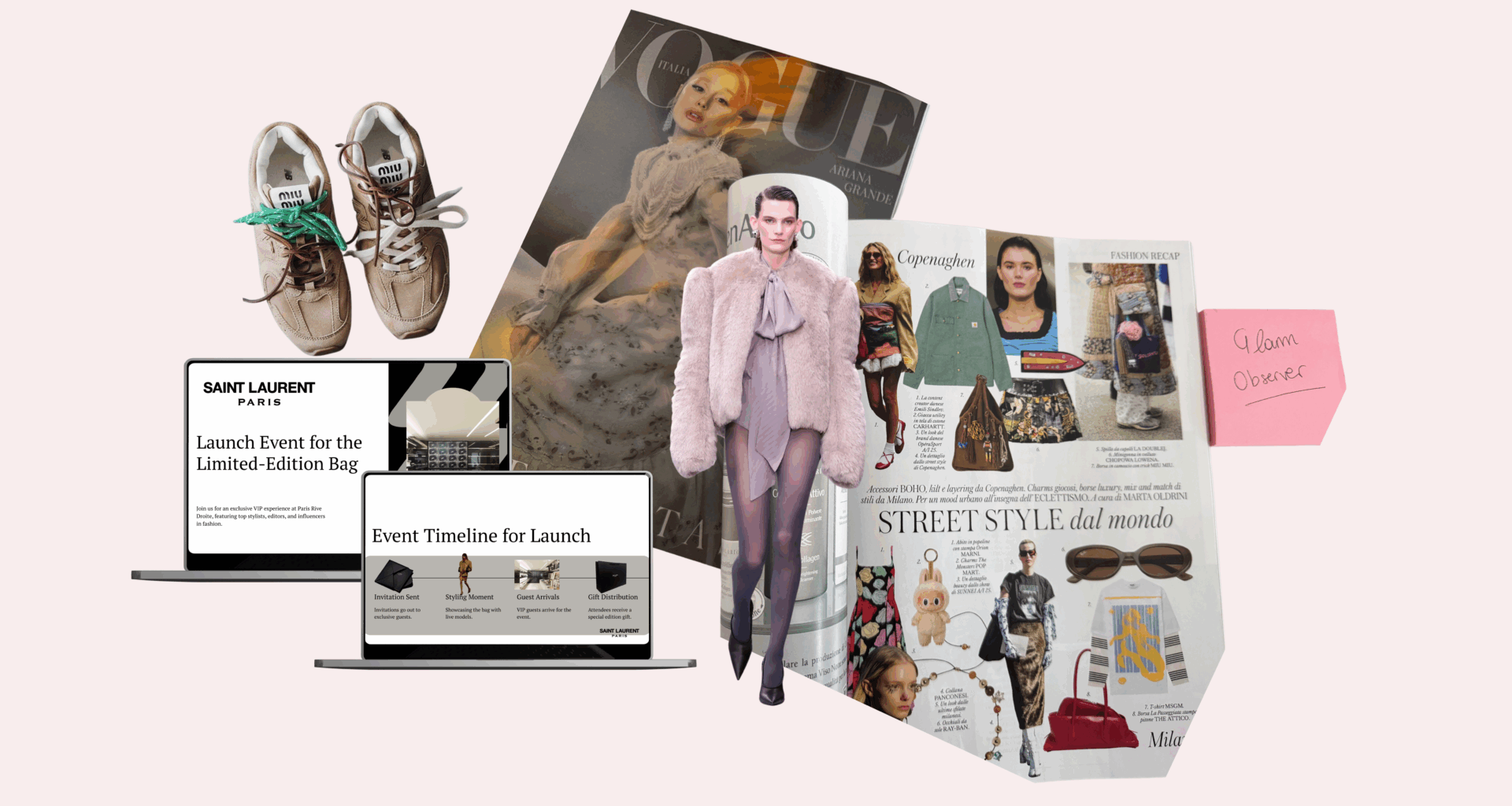
If you want to execute professional projects for your portfolio that will make your document look like you worked in fashion already, check out my course The Fashion Internship Simulator, where my students step into real fashion industry roles (Marketing Assistant at Saint Laurent or Miu Miu, Assistant Stylist at Vogue Italia, Editor-in-Chief for a week) and complete the actual tasks professionals in those positions handle every day. By the end, you’ll have four portfolio projects that don’t just look polished — they prove industry-level thinking.
There’s something I tell my students all the time, and I want to leave you with it: everything you do outside the fashion industry is a preview of what you will do inside it.
If you’re proactive now — building portfolio projects no one is asking you to build, learning Excel before any company has tested you on it, studying job descriptions like research documents, refining your work obsessively — you will be seen as someone who will keep being proactive once you’re inside. You’ll be seen as someone who will keep learning, keep growing, keep contributing.
And that is exactly the kind of person the fashion industry is looking to hire in 2026.
If you’re putting effort in before anyone is paying you to, the recruiter knows you’ll put even more in once they do.
Ready to Build a Portfolio That Actually Gets You Hired?
If you’re ready to stop guessing and start building a portfolio that actually reflects industry-level thinking, here’s where to go next:
🎥 Not ready for a course yet? Join my free fashion career webinar to learn the foundations of breaking into fashion in 2026.
🎓 My signature course: Break Into the Fashion Industry — the complete step-by-step program I built to help you land your first fashion internship or job, even with no experience or connections.
💼 Build your portfolio from scratch: Fashion Internship Simulator — work on 4 real fashion projects (PR, Marketing, Editorial, Styling) to add to your resume before your first internship.