


So, you’re about to graduate from university and you dream of working for a luxury fashion house , Chanel, Dior, Gucci, Prada, Saint Laurent, Hermès, Burberry, and the like. Just like most of my students who come to the Glam Observer Fashion Academy with the goal of landing a job in fashion. And just like me who once enrolled in a Master’s in Luxury Fashion Management with the dream of entering the field (I was actually fixated on the idea of becoming the CEO of Dior at first :D) and ended up working for Alexander McQueen (my very first fashion internship), Yoox-Net-a-Porter, and Kering.
I understand, working at a luxury brand is your BIG DREAM. You must be excited… but also wondering:
How do I actually break into luxury fashion as a graduate?
Is it even possible to land a job at a luxury brand without previous experience?
The truth is: luxury is competitive, but far more accessible than students think , especially when you understand what recruiters look for and how to build a profile that signals “luxury-ready.”
And also: Luxury doesn’t care if you have a fashion degree, experience, or connections (although if you have those you can use them to your advantage).
Luxury likes preparedness – from the way you apply and present yourself to the ‘luxury friendly’ skills to understanding its specificities compared to other brands.
In this complete guide, I will show you exactly what getting a job in luxury fashion entails.
1. What a “Graduate Role” in Luxury Fashion Actually Means
Here’s what counts as a graduate opportunity:
Graduate/Early Career Schemes at Luxury Groups
The graduate and early career programmes are designed specifically to serve as a launching pad for fresh graduates and professionals in the early stages of their careers.
You’ll find them at companies such as:
- LVMH (Horizons Program, Spring Graduate Program, and Brand-specific graduate programs) – think Dior, Louis Vuitton, Fendi, etc.
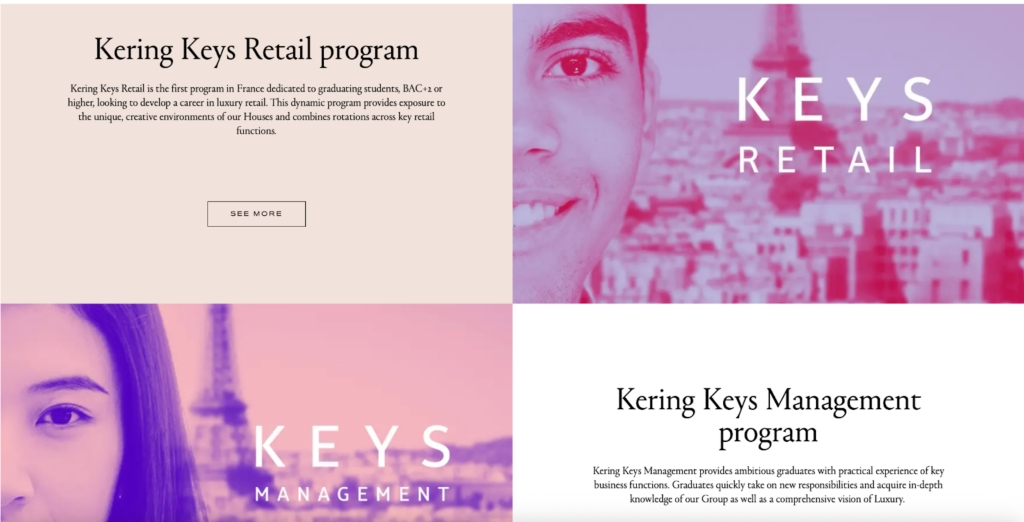
- Kering (Kering Keys): Gucci, Alexander McQueen, Balenciaga…
- Richemont: Cartier, Chloé, Alaia…
- Prada: Generation Prada Internship Program
- Harrods
This list is of course non exhaustive.

Graduate schemes usually include:
- 12–24 months of rotations
- Usually training in several departments (merchandising, marketing, retail, operations…) to introduce candidates to different sides of the business
- Some companies offer specific retail or management programs (like Kering Keys)
- Exposure to senior leaders and networking
- International experience (in some cases) with a few months spent at the company’s foreign branch
Eligibility criteria:
- Graduation date within a fixed period, typically between one year before and one year after the current year (so for example programs published in 2025 usually open to candidates graduating between September 2024 and 2026)
- Not having an existing contract within the group or brand
- Knowledge of foreign languages
- Open to international mobility
- Basic skills: Organization, adaptability, Excel, etc.
Important: if a company doesn’t have a graduate program, it does NOT mean it doesn’t hire recent graduates. Most of them offer entry-level roles for those.
Junior or Assistant Roles Designed for New Graduates
Luxury houses regularly hire fresh graduates into entry-level roles across different departments, such as (but not limited to):
- Assistant Buyer
- Assistant Designer
- Junior Merchandiser
- Marketing Assistant
- PR Assistant
- Digital Assistant
- Retail Management Trainee
These roles don’t require a graduate scheme and are often easier to secure if you completed internships during your studies.
Insider recruiter note:
Most assistant roles in luxury require 1 year of experience , but this includes internships.
If you’ve completed 1–2 internships, you are already competitive for these positions.
Fashion Internships for Graduates
If you haven’t completed any internships during your studies, or it wasn’t in the fashion sector, or it lasted a few months, completing an internship at a luxury company is often requested and highly recommended.
Most luxury internships are open to recent graduates – it’s usually specified in the job description.
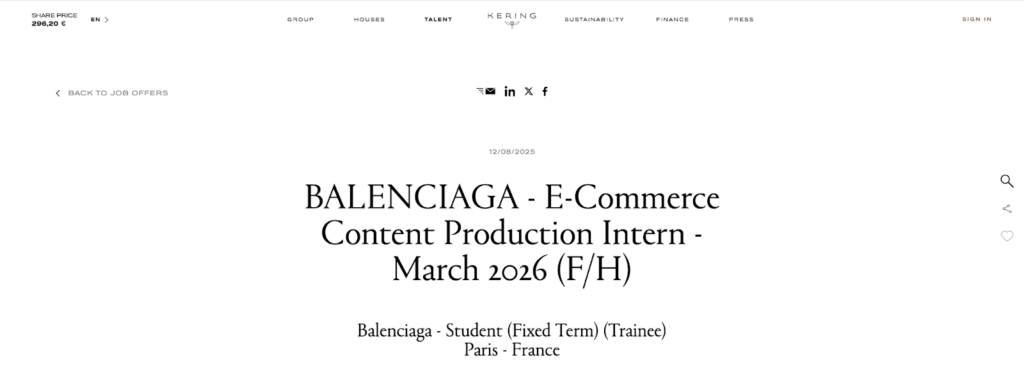

You can also apply to internships open to everyone (meaning not curricular and not necessarily for students or recent graduates) or even better – cold email your favorite brands directly asking for one (which is a strategy I teach inside my Break into the Fashion Industry course)
2. What Luxury Fashion Companies Look For in Graduates
Most aspiring fashion professionals want to work in luxury – I read it almost every day in my direct messages. But few actually understand what it entails behind the glamour and prestige. Working in luxury is different from other brands. Let me explain.
The Luxury Mindset
Luxury brands look for candidates who embody:
- High level of Professionalism: excellence and high standards in luxury = same expectations from professionals
- Strong attention to detail: from meticulous product design and packaging to neat e-commerce and store interiors, everything needs to be precise and shine.
- Curiosity, innovation & entrepreneurial spirit: luxury thrives on agile minds, people with a ‘can do’ mindset, and always eager to learn something new.
- Passion for luxury: You must have a genuine appreciation for luxury goods, craftsmanship, and understand the brand history (and show that passion in your applications and job interviews – more on that later)
The requirements for candidates are higher because the stakes are higher in the luxury industry. Working in the luxury field isn’t just about glamour and prestige; it involves an even more meticulous attention to product design, a polished visual identity, elevated customer service, and a strong image and reputation in the media.
This doesn’t mean that other fashion brands don’t have high standards or demanding roles , they absolutely do. However, luxury operates under a different set of expectations. Sales targets are significantly higher, VIP customers need long-term relationship building, and the level of service, discretion, and personalization required is far more advanced.
Even in corporate roles, decisions are shaped by these realities: pricing strategies, assortment planning, communication tone, and customer experience must all protect exclusivity while driving profitability. This is why luxury brands place such strong emphasis on precision, professionalism, and business awareness , not because other brands are less demanding, but because the stakes, margins, and expectations in luxury are fundamentally different.
Commercial Awareness
Luxury = creativity + business.
Every beautiful design, campaign or runway is a result of a commercial strategy behind it.
Therefore, graduates need to understand:
- What makes a product sell
- Why brand image drives pricing
- How storytelling shapes demand
- What differentiates luxury from premium
Even entry-level roles require this mindset, which you can develop by reading and analyzing fashion news, reports, and understanding how the industry works (for example in my newsletter)
The Luxury Candidate Profile
Here is what most people get wrong about luxury companies: They are NOT recruiting only candidates with a fashion degree from a prestigious school or through word of mouth.
Luxury brands are usually open to all skill levels and previous experiences, because they want to hire diverse talent. They are not looking for someone who checks all the boxes but potential.
Skills Luxury Prioritizes
- Organizational skills
- Attention to detail
- Microsoft Excel
- Proactive problem-solving
- Team collaboration
- Foreign languages
- Adaptability
These skills are not necessarily developed in jobs but throughout your life, studies, and personal projects.
Luxury brands often hire graduates from these fields:
- Business
- Marketing
- Economics
- Engineering
- Arts
- Communications
- Humanities
- Social sciences
You DO NOT need a fashion degree to work in the luxury industry. What you studied matters less than your ability to connect it to the role and your skills.
3. Graduate-Friendly Luxury Houses
Some luxury brands are especially known for hiring graduates.
Fashion Groups with established graduate programs
- LVMH
- Richemont
- Kering
Luxury Brands that regularly hire recent or soon-to-be graduates for internships and entry-level roles
- Chanel
- Dior
- Louis Vuitton
- Prada
- Balmain
- Bottega Veneta
- Balenciaga
- Gucci
- Alexander McQueen
- Saint Laurent
- Fendi
- Kenzo
- Rimowa
- Givenchy
- Loro Piana
- Loewe
- Celine
- Cartier
- Tiffany & Co.
These companies frequently promote from within, making them ideal starting points for your career.
BUT: if you don’t see an open position, don’t wait or give up and ask for one by sending a cold email.
4. Applying for Luxury Graduate Roles
When Do Applications Open?
- Graduate schemes usually open August–November for the following year.
- Entry-level roles and internships open year-round.
Tip: Set job alerts for LVMH, Richemont, Kering, and individual maisons on LinkedIn.
Where to find opportunities in fashion for graduates?
Graduate opportunities in luxury fashion are rarely found in just one place , and relying only on one is one of the biggest mistakes students make.
- Luxury groups like LVMH, Kering, and Richemont often centralise their graduate schemes and internships on their official career websites, which should be your first stop.
- Individual maisons also post entry-level and assistant roles directly on their own career pages or LinkedIn.
- Beyond job boards, you can access hidden opportunities through cold emails sent directly to fashion recruiters and professionals in their favorite departments.
In luxury fashion, visibility and initiative matter , often, the best opportunities go to candidates who actively look beyond the official job boards and reach out before a role is advertised.
5. Craft a Luxury-Ready Profile
Crafting a Luxury-Standard CV
If you recently graduated, Education goes at the top.
But here’s the critical part:
Most students only list the name of their degree , and stop.
That is a major mistake.
Recruiters want to see:
- Key coursework that can be applicable in the fashion industry (e.g: if you didn’t study fashion journalism, marketing, or management, but simply journalism, marketing, or management, it still counts because the fundamentals are the same)
- Relevant projects and thesis
- Software/tools learned
- Research topics
- Achievements (presentations, awards, group work)
Include these as bullet points (3-5) under your degree.
If you studied fashion, I still recommend to include these bullet points, as it will show you’re thinking beyond the title of your fashion degree.
Example 1: Fashion Management / Luxury Management Degree
Bachelor in Fashion Management
University of X
- Coursework: Luxury Brand Management, Fashion Marketing, Trend Forecasting
- Skills gained: fashion market analysis, product positioning, analytical thinking
- Field trip to X brand where I gained deep insight into the behind-the-scenes operations and product development and connected with professionals (relevant to include if you apply for that brand)
Example 2: Economics / Finance Degree
Bachelor in Economics
University of X
- Coursework: Microeconomics, Statistics, Market Analysis, Financial Modelling
- Skills gained: analytical thinking, pricing analysis, data-driven decision making, advanced Microsoft Excel, forecasting
- Group Project: Economic analysis of consumer spending in the luxury sector
Example 3: Arts Degree
Bachelor in Art History
University of X
- Coursework: Modern Art, Visual Culture, Cultural Theory
- Skills gained: visual analysis, storytelling, cultural research, critical thinking, written communication
- Thesis: Visual identity and symbolism in luxury fashion houses
This immediately shows a recruiter why your education matters and how you connect it to the role. It shows you’re thinking strategically.
6. Showcase your skills
Graduates often assume luxury companies want the perfect fashion CV with a degree from Istituto Marangoni or the Fashion Institute of Technology or 3 internships at other luxury brands.
Not true.
They want potential , shown through mindsets, skills, and projects that align with luxury values.
The easiest way to showcase that is through a portfolio. You can create it at home, without any previous experience.
Your portfolio can include:
- Trend Moodboards
- Brand analysis, Case studies, or Articles
- PR or marketing campaign ideas
- A mock fashion show or brand event production plan
- Competitor analysis
- A mini magazine created on Canva
- Etc.
A portfolio proves your thinking, your skills, and your potential , even without experience.
Something I recommend my students is to frame those personal projects as internship simulations. That’s right – it doesn’t matter that these projects aren’t ‘real’ and done in a real fashion office; what matters is that you showed up and did them. This ability to take initiative before you are offered a position is GOLD to recruiters!
I teach how to build hands-on assignments in the Fashion Internship Simulator. You will work on 4 real projects, designed to mimic the exact assignments you’d get interning at top companies like Vogue, Miu Miu, and Saint Laurent.
7. Back up your formal studies with online courses
Although I got a master’s in Luxury Fashion Management, that’s not what really helped me land my first internship at Alexander McQueen. When the recruiter saw my resume, she told me that they were impressed with the online fashion courses I took in my free time:
“We chose you because you went beyond your degree , it shows initiative.”
This is exactly what luxury houses want to see.
If you’re looking for online courses that will help you understand the industry better, prepare for it, and help you land a job in the process – choose the Glam Observer Fashion Academy.
Final Advice: Your Luxury Career Action Plan
1. Understand what type of graduate opportunity fits you
Graduate Scheme? Internship? Junior role?
2. Build a luxury-ready profile
Degree → bullet points → skills → portfolio.
3. Apply strategically and early
Check out regularly for advertised positions and send cold emails to luxury brands
You’re more ready than you think to land your dream graduate role at a luxury fashion company. Luxury fashion may look intimidating from the outside, but recruiters aren’t looking for perfection; they’re looking for potential supported by initiative and professionalism. Your first role in luxury fashion is absolutely within reach!